
Microsoft 365 Pricing Changes in 2026: What They Mean for Intune
Disclaimer: I create this content entirely on my own time, and the views expressed here are mine alone (not my employer’s). Because I love leveraging new tech, I use AI tools like Gemini, NotebookLM, Claude, Perplexity and others as a “digital team” to help research and polish these articles so I can share the best possible insights with you!
Have questions, ideas to share, or just want to connect? I’d love to hear from you! Check out my About Page to learn more about me or connect with me.
Microsoft is introducing broad changes to Microsoft 365 in 2026 that go beyond Intune, combining a noticeable price increase with a push toward more tightly integrated security, collaboration, and AI capabilities across the suite. Core plans like Microsoft 365 E3 and E5 are gaining enhanced features in areas such as threat protection, data security, and advanced compliance, alongside new AI‑driven enhancements in apps like Teams and Outlook, with the goal of making the higher subscription cost easier to justify for organizations standardizing on the platform. At the same time, Microsoft is simplifying parts of its licensing model and adjusting discounts, which means many customers will see both higher per‑user pricing and fewer built‑in volume breaks, making it more important to rationalize SKUs and ensure users are matched to the right plan level.
The big picture: M365 and Intune in 2026
Microsoft is rolling advanced Intune capabilities into Microsoft 365 E3 and E5 and raising core M365 prices from July 1, 2026; Intune Plan 1/2 also remain available as standalone or add‑on options. The net effect is that many organizations will pay more per user for E3/E5, but will no longer need as many separate Intune Suite add‑ons to get capabilities like Remote Help, Advanced Analytics, and specialty device management.
Microsoft is positioning Microsoft 365 as the default way to buy Intune by baking more Intune Suite features directly into E3/E5 and EMS E3. At the same time, list prices for those suites will go up in mid‑2026, with most commercial plans seeing increases in roughly the mid‑single to low‑double‑digit percentage range.
In practice this means:
- Organizations already on M365 E3/E5 plus Intune Suite could see overall spend flatten or decrease, as some add‑ons become redundant.
- Organizations just using “plain” Intune features will see higher suite pricing but also gain access to more advanced endpoint tools.
What’s changing in E3 vs E5 vs Intune
2026 Microsoft 365 & Intune Comparison Guide
The following table outlines the price changes and feature additions taking effect in July 2026.
| License | 2025 Price (Est.) | 2026 Price (Est.) | Key Endpoint & Intune Changes |
| M365 E3 | $36.00 | $39.00 | Adding Remote Help, Advanced Analytics, and Plan 2 capabilities (App Tunneling/Specialty Devices). |
| M365 E5 | $57.00 | $60.00 | Adding Full Intune Suite: Cloud PKI, Endpoint Privilege Management, and Enterprise App Management. |
| Intune Plan 1 | $8.00 | $8.00 | Remains the baseline for standard device/app management. No significant price change reported. |
| Intune Plan 2 | $4.00 | $4.00 | Focuses on specialty devices. Most features are being folded into M365 E3/E5 bundles. |
Features Changes
What this means for your licensing strategy
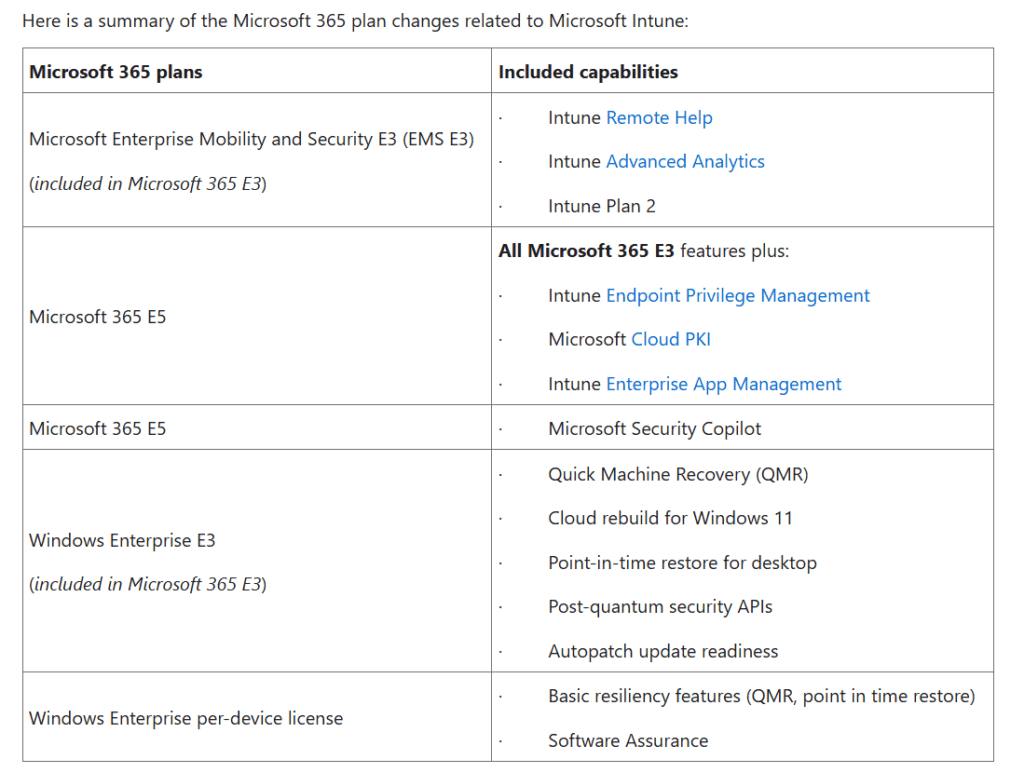
- For organizations already on M365 E3 or E5 with Intune Suite add‑ons, 2026 can be an opportunity to simplify licensing by retiring redundant Intune Suite SKUs while accepting a higher but more predictable per‑user suite price.
- For organizations buying Intune standalone (Plan 1/2), moving some or all users into M365 E3/E5 may now make more financial sense, because core productivity, security, and advanced Intune tools increasingly live in those suites.
- For large EA customers, the removal of built‑in volume discounts and the July 2026 price rise together make proactive modelling and negotiation essential before the next renewal term starts.
From Microsoft:
Key Referenced Sources
- Advancing Microsoft 365: New capabilities and pricing update (2025‑12‑03)
- Microsoft 365 adds advanced Microsoft Intune solutions at scale (2025‑12‑03)
- Microsoft Intune Suite Changes and 2026 Price Update (2025‑12‑11)
- Microsoft Intune Pricing Plans and Licensing Options [2026 Guide] (2026‑01‑05)
- Microsoft Intune Pricing: A No‑Nonsense Breakdown for 2026 (2026‑01‑07)
- Microsoft 365 Price Increases Will Take Effect July 2026 (2025‑12‑10)
- Microsoft 365 Pricing Update: What’s Changing and How to Prepare (2025‑12‑10)
- Microsoft 365 Pricing Changes from July 1, 2026 – Official (2025‑12‑17)
- Microsoft 365 Licensing Changes: What Businesses Need to Know in 2026 (2026‑01‑01)
- July 2026 Microsoft 365 Pricing Changes (2025‑12‑28)
- Guide to Microsoft 365 Pricing and Feature Changes for 2026 (2025‑12‑14)
- Microsoft 365 prices are increasing: What you need to know (2025‑12‑09)
- Microsoft 365 Government: New capabilities and pricing update (2025‑12‑03)
- Microsoft 365 Price Increase 2026: What to Know (2026‑01‑05)
- Microsoft Announces July 2026 Price Increases for M365 Plans (2025‑12‑04)
Do you have ideas of comments?
Please let me know! Send me a note to my X account: @jorper98