Practical AI Use: AI-First Fashion Lab
Part of: AI Learning Series Here
Quick Links: Resources for Learning AI | Keep up with AI | List of AI Tools | Local AI | AI Agents | Future of Work
Subscribe to JorgeTechBits newsletter
Explore the Latest Token Prices
Disclaimer: I create this content entirely on my own time, and the views expressed here are mine alone (not my employer’s). Because I love leveraging new tech, I use AI tools like Gemini, NotebookLM, Claude, Perplexity and others as a “digital team” to help research and polish these articles so I can share the best possible insights with you!
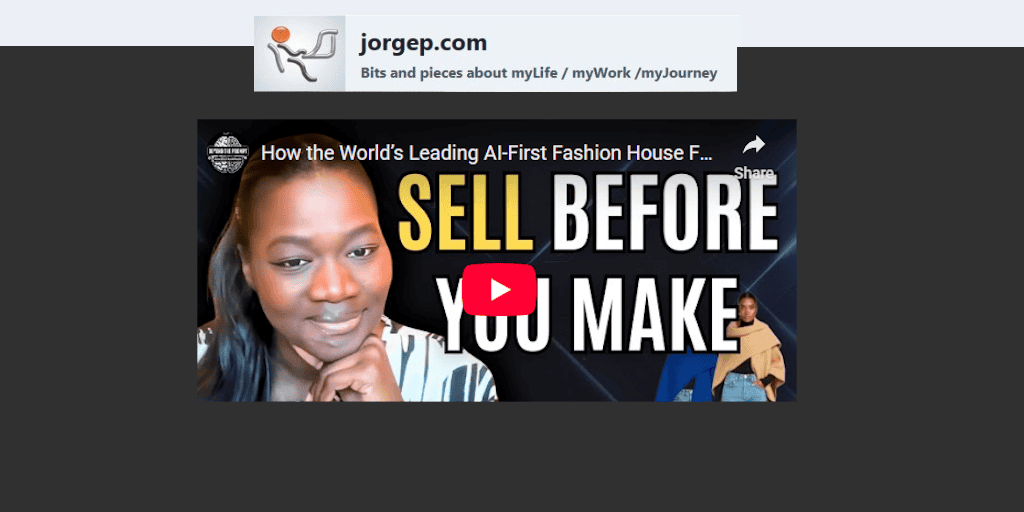
I finished watching a conversation with Diarra Bousso, founder of DIARRABLU, and I haven’t been able to stop thinking about it.
The video was created by the team behind Beyond the Prompt, a podcast and content series that explores how people and organizations are using AI in real work, with a focus on practical stories, frameworks, and tactics that can be applied immediately as AI capabilities accelerate. Hosted by Jeremy Utley, a longtime Stanford School instructor focused on creativity and innovation, and entrepreneur Henrik Werdelin, founder of ventures like BarkBox and Prehype, the show brings together a blend of creative and operator perspectives; in this episode, they feature guest Diarra Bousso.
The interview presents something rare: a genuinely novel approach to building a company that isn’t just incrementally better than existing models but fundamentally reimagined from the ground up. At its core, the idea is deceptively simple—run a fashion company like a scientific laboratory—but the implications ripple out in ways that touch everything from cash flow and sustainability to human creativity and how we structure our daily lives.
The Central Insight: Flipping Fashion Economics
What immediately grabbed my attention was how Diarra has completely inverted the traditional fashion business model. In conventional fashion, brands design collections months in advance, produce large quantities based on trend forecasts and educated guesses, and then hope customers will buy what’s been made. The result is an industry drowning in overproduction, with massive amounts of unsold inventory that gets deeply discounted or, worse, destroyed entirely.
DIARRABLU does the opposite. They use AI to generate design concepts and showcase them as images tied to raw materials and production capabilities. But here’s the crucial part: the actual garments don’t exist yet. Customers see a product that exists only as an image and a promise. When they buy, they’re effectively funding its creation and signaling real demand before any manufacturing costs are incurred.
This approach produces what Diarra calls “pure cash”—revenue collected without the upfront inventory costs that typically strangle fashion startups. The cash flow equation is fundamentally different. Instead of investing heavily in production and hoping it sells, the company validates demand first, then produces only what customers have voted for with their wallets. It’s not just more efficient; it’s a complete restructuring of how capital flows through the business.
The practical benefits are enormous. The company can measure real demand before committing to production, allocate capital only to validated designs, and avoid tying up cash in unsold stock that might sit in a warehouse for months or never sell at all. Money as signal replaces guesswork as strategy.
AI as Creative Partner: Technology That Amplifies Rather Than Replaces
One of the most refreshing aspects of this conversation was Diarra’s nuanced perspective on AI’s role in the creative process. In an era where discussions about AI often swing between utopian hype and existential dread, her approach feels remarkably grounded and practical.
She uses AI tools to rapidly generate multiple design variations from concepts, patterns, or raw materials. The AI churns out combinations, patterns, and visual options at a speed and volume no human designer could match. But—and this is critical—AI doesn’t dictate taste or make final decisions. Human judgment remains at the absolute center of the process.
The humans on the team are the ones selecting which designs feel true to the brand, which images resonate emotionally, and which directions deserve further exploration. They’re deciding what tells a story, what has coherence, what deserves to exist in the world. In this model, AI handles breadth and speed while humans own depth, vision, and the subtle pattern recognition that defines a distinctive brand voice.
This division of labor actually amplifies human creativity rather than diminishing it. By offloading the mechanical work of generating variations and exploring vast possibility spaces, AI frees up more time and mental energy for the high-value, high-judgment activities that are hardest to automate: vision, narrative, aesthetic coherence, and the creative decisions that make something feel alive rather than algorithmic.
It’s a partnership model that feels sustainable and exciting. The technology doesn’t replace the human; it removes constraints that previously limited how much ground the human could cover.
Want More Updates? =>Subscribe to my JorgeTechBits newsletter
Experimentation as an Operating System
What makes DIARRABLU’s approach work isn’t just clever use of technology. The deeper foundation is a mindset that treats experimentation not as a tactic you deploy occasionally but as the operating system for how the entire company—and Diarra’s life—functions.
This philosophy was forged during an extraordinarily difficult period. Diarra experienced a life-changing accident that left her in recovery, relearning basic abilities that most of us take for granted. During that time, she used small creative experiments—turning dreams into photographs and art—as milestones in her healing process. Each tiny creative task became a way to measure progress and rebuild capability.
She describes training herself to view each attempt not as a pass/fail event but as a step in a longer learning curve. The word “yet” became a mental tool that transformed how she processed setbacks. “I can’t do this” became “I can’t do this yet,” which fundamentally changes the emotional weight of failure. Instead of sources of shame, setbacks became data points that informed the next iteration.
After months of using this approach to eventually regain her ability to walk and remember, the experimental mindset became permanently embedded in how she made life decisions. She spent years traveling widely, exploring different fields—fashion, art, education, mathematics—treating each as a structured trial. Try something for a week or a month, see what happens, gather data, and adjust accordingly.
That same philosophy now shapes every aspect of DIARRABLU. New ideas aren’t framed as fixed plans to execute but as hypotheses to test. This completely changes the emotional and operational dynamic around trying new things. When something doesn’t work, it’s not a failure that reflects on anyone’s competence—it’s simply data that informs the next test. The focus shifts from being right to learning fast.
Making Experimentation Operational
What impressed me most was how Diarra has operationalized this experimental mindset throughout the entire organization. It’s not just a personal philosophy or something reserved for leadership decisions. Experimentation is expected at every level, from junior team members to external collaborators.
A junior marketer might propose an experiment around TikTok content, and Diarra’s response isn’t “Are you sure this will work?” or “Have you thought through all the risks?” It’s “What are you testing this month?” This gives team members genuine freedom to try things, but within clear constraints: tests should be small, cost-effective, and structured around specific learnings.
At the same time, the company isn’t casual about performance. Diarra emphasizes accountability through KPIs—key performance indicators that define what success looks like for each experiment. The cultural message is remarkably clear: everyone can and should experiment, experiments must be purposeful rather than random, and results matter and must be measured.
This blend of freedom and rigor is what makes it work. Without the freedom, you get a culture of playing it safe and waiting for permission. Without the rigor, you get chaos and wasted resources on unfocused activity. Together, they create what Diarra and the hosts describe as a “founder of the future” mindset—a team constantly increasing their rate of learning, guided by data but energized by curiosity.
Sustainability by Design, Not Afterthought
One aspect that really resonated with me was how naturally sustainability emerges from this model rather than being grafted on as a feel-good marketing angle. When you only produce items that customers have already effectively pre-ordered or strongly signaled interest in, you eliminate overproduction by design. The business model itself drives sustainability rather than fighting against economic incentives.
The benefits cascade through multiple dimensions. There’s dramatically less textile waste from unsold inventory. Resource usage drops because production is tied to verified demand rather than optimistic forecasts. The entire machinery of clearance sales, outlet stores, and the ultimate destruction of surplus products becomes unnecessary.
This stands in stark contrast to conventional fashion, where overproduction is practically built into the DNA of how the industry operates. Brands produce large collections months in advance, often guessing at trends and quantities, then discount heavily or destroy whatever doesn’t sell. It’s an economically wasteful and environmentally destructive model that everyone knows is broken but has been remarkably resistant to change.
What struck me was how Diarra connects this business-level sustainability to personal sustainability. She talks about how “sustainability starts with the founder” and uses the same experimental approach to design a life that protects her time, energy, and long-term health. The principles that minimize waste in production—test small, measure, iterate, optimize for what actually works—are applied to daily routines, workloads, and personal systems.
There’s something profound about that parallel. The same mindset that makes the business more sustainable also makes the founder’s life more sustainable. It’s not about working harder or sacrificing more; it’s about being more intentional about where energy goes and continuously refining systems to eliminate waste.
Life as Continuous Experiment
Beyond the business mechanics, the conversation repeatedly returned to a philosophical stance that life itself can be treated as an ongoing experiment. After her accident and recovery, Diarra spent years deliberately exploring—traveling widely, trying different fields, treating each new direction as a structured trial with a defined time horizon.
Her parents eventually pushed her to “get her life together” after years of exploration and a depleted 401k, which led her to Stanford and a more conventionally structured career path. But the experimental mindset remained. She continued to view each new step as another hypothesis about what kind of work, impact, and lifestyle would be meaningful.
Today, that same philosophy informs how she uses AI and systems to reclaim time and energy. Instead of accepting default calendars, workloads, or habits, she continuously tests and refines, looking for ways to optimize for joy, long-term health, and high-impact creative work.
What makes this compelling isn’t just that it worked for her—though it clearly has—but that it offers a framework anyone can adopt. You don’t need to experience a life-changing accident to start treating decisions as experiments. You don’t need to be a founder to apply “I can’t do this yet” to challenges you’re facing. The mindset is portable and scalable.
Why This Matters Beyond Fashion
I keep coming back to this conversation because the principles extend so far beyond fashion. The specific tactics—AI-generated designs, sell-before-build, pre-validation of demand—are interesting, but they’re surface level. The deeper pattern is about how to structure any creative or entrepreneurial endeavor in a world where technology can handle breadth while humans focus on depth.
Use AI to generate options and accelerate learning, not to replace human taste and judgment. Treat products, strategies, and even daily routines as experiments with explicit hypotheses and measurable outcomes. Validate demand before making heavy investments in production or infrastructure. Design both business and life systems to minimize waste—of money, materials, time, and energy.
These aren’t just business tactics. They’re a framework for building more thoughtful, sustainable, and creatively fulfilling enterprises in any domain. They’re also personally applicable: the experimental mindset, the “yet” reframing, the continuous refinement of systems—all of this translates to how we structure our own lives and work.
What Diarra has built with DIARRABLU is remarkable not just because it’s a successful fashion company but because it demonstrates what becomes possible when you combine the right mindset with the right technology in service of a clear vision. The technology amplifies rather than replaces. The experimentation accelerates learning without creating chaos. The sustainability emerges naturally from the model rather than requiring constant effort to maintain.
It’s one of the best examples I’ve seen of technology being used thoughtfully—not because it’s trendy or because everyone else is doing it, but because it genuinely unlocks new ways of working that align with human creativity and long-term sustainability.
Worth watching if you’re thinking about the intersection of AI, creativity, and building things that last. More than that, it’s worth thinking about what aspects of this approach might apply to whatever you’re building—whether that’s a company, a creative practice, or simply a more intentional life.
Have questions, ideas to share, or just want to connect? I’d love to hear from you! Check out my About Page to learn more about me or connect with me.