
Crossing the Chasm: Are Early Adopters the Real Market
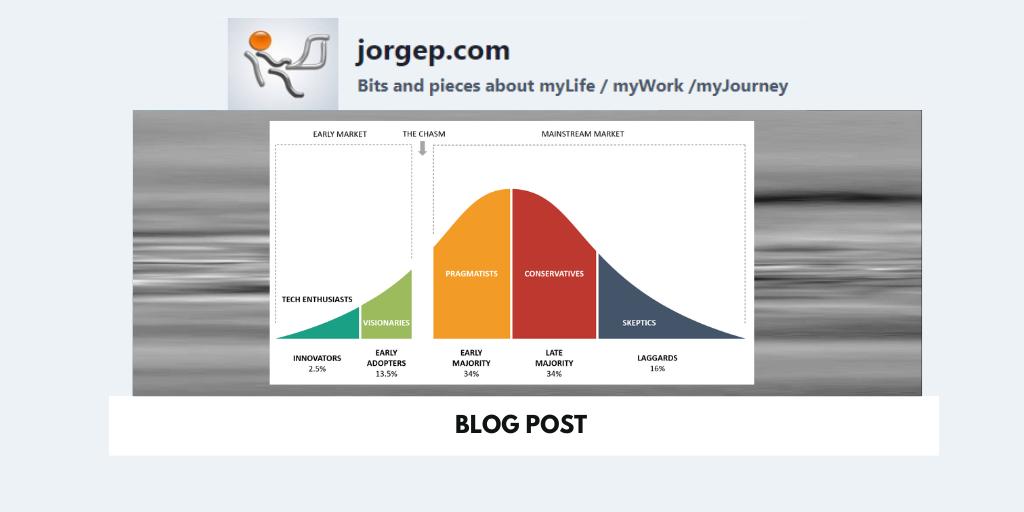
post Updated on February 2022 and June 2025 again to include AI
Every technology startup dreams of that magical moment when their product moves from “interesting experiment” to “industry standard.” They land their first customers, gain traction with enthusiasts, and assume mainstream success is simply a matter of time and marketing spend.
Then something strange happens. Growth stalls. The excited early customers keep buying, but the broader market remains indifferent. The company has reached the chasm—a gap so many technology companies never cross.
Understanding this dynamic is essential for anyone building or marketing technology products. The strategies that win early adopters often prevent you from reaching the mainstream. The customers you serve first may be the worst teachers for how to sell to everyone else.
The Technology Adoption Lifecycle
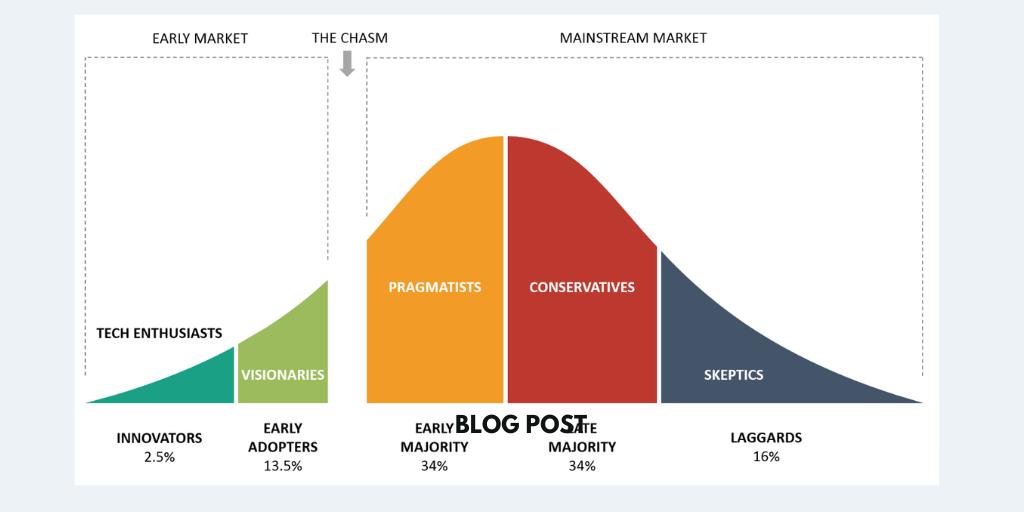
In 1962, sociologist Everett Rogers introduced the bell curve that defines how innovations spread through populations. He identified five categories of adopters:
- Innovators (2.5%) are technology enthusiasts. They buy first, tolerate bugs, and find joy in the newness itself. They do not need marketing—they hunt for innovations. For them, the technical challenge is the appeal.
- Early Adopters (13.5%) are visionaries. They see strategic advantage in being first. They accept risk for competitive differentiation. Unlike innovators, they care about business outcomes, not just technology.
- Early Majority (34%) are pragmatists. They want proven solutions to real problems. They buy only when references exist, when standards are settled, when risk is minimized. They are the beginning of the mainstream market.
- Late Majority (34%) are conservatives. They adopt under pressure, when remaining outside becomes harder than joining. They want complete solutions, mature support, and vendor stability.
- Laggards (16%) are skeptics. They resist change until forced, often by circumstance rather than choice.
The curve suggests smooth progression. It implies that winning innovators leads naturally to early adopters, then to the majority. This is dangerously wrong.
The Chasm Is Real
Between early adopters and early majority lies a psychological gap far wider than the percentages suggest. Geoffrey Moore named this the “chasm” in his 1991 book, and it remains the single most important concept in technology marketing.
Early adopters and early majority customers are fundamentally different people with different motivations. Treating them as points on a continuum leads to strategy failure.
- Early adopters are visionaries. They want competitive advantage. They will assemble partial solutions, integrate with existing systems themselves, and accept training burdens for long-term gain. They want to be first. They want to change the world (or at least their industry). They are buying a transformation.
- Early majority buyers are pragmatists. They want incremental improvement, not revolution. They demand complete products, proven interoperability, and minimal disruption. They want to be second—or preferably fifth. They are buying a solution to a specific problem, not a vision of the future.
This difference creates the chasm. The references that convince early adopters mean nothing to pragmatists. Early adopters trust other visionaries. Pragmatists trust other pragmatists. The social proof that accelerates one market segment does not transfer to another.
Why Companies Fall In
The chasm is invisible to many technology companies until they are falling into it. Several factors create this blindness.
- Founder-market fit becomes founder-market mismatch. Founders are often visionary early adopters themselves. They understand their first customers intuitively. They assume the rest of the market thinks similarly. When pragmatists do not respond to the same messaging, founders blame the sales team or the marketing spend rather than the fundamental strategy.
- Early revenue creates false confidence. A company with enthusiastic early adopters often sees 50% or 100% year-over-year growth. This looks like traction. It feels like product-market fit. But early adopter revenue has different characteristics—higher churn, higher support costs, more customization demands. The unit economics that work for visionaries collapse when applied to mainstream customers.
- Marketing efficiency deceives. Early adopters find you. They attend the same conferences, read the same publications, belong to the same networks. Customer acquisition cost appears low because the customers self-select. When the company tries to reach pragmatists through the same channels, efficiency collapses. The low-cost acquisition was a function of audience overlap, not marketing skill.
- The technology improves but adoption stalls. Companies often interpret slow mainstream adoption as a product deficiency. They add features, improve reliability, reduce price. But the problem is rarely the product. The problem is the positioning, the messaging, the reference base, the whole product definition—none of which early adopters required.
Strategies for Crossing
Crossing the chasm requires deliberate strategic shifts, not incremental improvements.
Focus ruthlessly on a single market segment. The temptation is to pursue multiple verticals simultaneously, to keep options open, to avoid betting on the wrong horse. This guarantees failure. Pragmatists buy from market leaders in their specific segment. You cannot be a leader in five segments simultaneously. You must choose one beachhead, win it completely, then expand.
The choice of segment matters enormously. Ideal chasm-crossing targets have:
- A compelling, urgent problem unsolved by current alternatives
- Budget allocated and authority to spend
- Referenceability (willingness to speak to other prospects)
- Ecosystem adjacency (partners who can complete the solution)
- Strategic value (adjacent segments you can expand to once established)
- Redefine the whole product. Early adopters buy technology. Pragmatists buy solutions. The “whole product” includes not just your software but installation, training, integration services, third-party add-ons, support, and documentation. Early adopters assemble this themselves. Pragmatists demand it be pre-assembled and guaranteed to work.
- This often requires partnerships. The chasm-crossing company must identify who else needs to be in the solution and formalize those relationships before mainstream customers will buy.
- Change your references. The testimonials that convinced early adopters—technical sophistication, competitive advantage, vision—repel pragmatists. You need new case studies emphasizing reliability, ROI, smooth implementation, and compatibility with existing systems. You need references from companies the mainstream recognizes and respects.
- This is the chicken-and-egg problem of chasm crossing. You need mainstream references to sell to the mainstream, but you cannot get those references until you have sold to the mainstream. The solution is aggressive investment in your beachhead—discounting, extensive professional services, whatever it takes to create those first success stories.
- Shift positioning from revolutionary to evolutionary. Early adopter marketing emphasizes disruption, transformation, and competitive advantage. Mainstream marketing emphasizes improvement, compatibility, and risk reduction. The same product must be repositioned as making life better rather than making life different.
- Build for the herd, not the mavericks. Distribution and support models optimized for early adopters—direct sales, self-service configuration, community forums—fail for mainstream customers who expect mature vendor relationships. Channel partners, certified implementation, and professional support organizations become necessary investments.
Modern Examples
The chasm framework explains many technology stories.
- Slack crossed by choosing startups. Enterprise messaging was not new. Slack won early adopters with superior design and integrations. But their chasm crossing came from deliberately targeting startups as their beachhead. Startups had urgent communication pain, limited existing infrastructure, and high referenceability. Once dominant among startups, Slack expanded to enterprises already familiar with the product through their startup acquisitions and partnerships.
- Virtual reality has not crossed. Despite billions invested, VR remains stuck with early adopters. The technology improved dramatically, but the “whole product” is incomplete. No single compelling use case dominates. The ecosystem remains fragmented. Mainstream customers see novelty, not necessity. Each VR generation contains better technology but the same strategic failure.
- Electric vehicles are crossing now. Tesla won early adopters with performance and environmental vision. But mainstream adoption required infrastructure (charging networks), competitive pricing, and proven reliability. The crossing is happening not because batteries improved (they did) but because the whole product definition—financing, charging, and service networks—finally supports pragmatic buyers.
- Blockchain remains in the chasm. Early adoption was spectacular—cryptocurrency speculation, NFT trading, and decentralized finance experiments. But mainstream pragmatists see complexity, regulatory uncertainty, and unclear problem-solving. The technology works; the market positioning and whole product definition do not yet serve mainstream needs.
- Generative AI is sprinting toward the chasm. Unlike previous cycles, GenAI achieved massive early adoption in record time through “low-friction” tools like ChatGPT. However, to cross into the mainstream enterprise market, it must solve the “pragmatist’s requirements”: data privacy, factual accuracy (hallucination fixes), and clear ROI. We are currently seeing the shift from “cool demo” to “integrated workflow,” which determines if it will bridge the gap or stall as a high-end novelty.
Implications for Builders
Understanding the chasm changes how you build and time your company.
- Early product decisions commit you to a market. Features that delight early adopters—extensibility, customization, cutting-edge integration—add complexity that mainstream customers reject. Technical debt is less dangerous than feature debt that creates the wrong whole product.
- Timing the crossing is strategic. Cross too early, before product maturity or reference development, and you burn resources inefficiently. Cross too late, and competitors establish beachhead positions you cannot dislodge. The chasm is not something to ignore until growth stalls. It is something to plan for from the earliest stages.
- Investor expectations must align. Venture capital often pushes for rapid scaling before chasm crossing is achieved. This creates pressure to pursue multiple segments prematurely, to lower prices for volume, to hire sales teams before positioning is resolved. The result is often spectacular flameouts—companies that reached significant revenue but could never achieve sustainable economics.
- Team composition must evolve. The skills that create breakthrough technology differ from those that build reliable operations. The founders who inspire early adopters rarely inspire mainstream corporate buyers. Organizational evolution—not just product evolution—is required for crossing.
Why This Matters Now
Technology cycles accelerate. What took decades—adoption of personal computing, internet connectivity, mobile phones—now takes years. The chasm appears faster, and companies have less time to recognize and respond to it.
Artificial intelligence currently presents the most visible chasm challenge. Early adopters experiment with large language models, build agents, and attempt transformation. Mainstream organizations struggle to identify specific applications, manage the risks of hallucinations, integrate with existing workflows, and justify the costs. Many AI startups will master early adopter markets and never cross to mainstream. The ones that succeed will be those that recognize the chasm is coming and prepare their beachhead strategy before revenue growth stalls.
The technology adoption lifecycle is not destiny. It is a framework for understanding customer psychology. The companies that master this understanding—segmenting their markets, building the whole product, securing the right references—cross the chasm to build sustainable mainstream businesses. Those that ignore it continue to serve enthusiastic minorities while wondering why greatness never arrives.
Your early adopters are valuable. They provide feedback, funding, and energy. But they are not your market. The sooner you recognize the difference, the better your chances of building something that lasts.
Resources
Books
- Crossing the Chasm: Marketing and Selling High-Tech Products to Mainstream Customers by Geoffrey A. Moore (1991, revised 2014)
- Inside the Tornado: Strategies for Developing, Leveraging, and Surviving Hypergrowth Markets by Geoffrey A. Moore
- The Innovator’s Dilemma: When New Technologies Cause Great Firms to Fail by Clayton M. Christensen
- Diffusion of Innovations by Everett M. Rogers (original work on adoption curves)
Articles and Frameworks
- Harvard Business Review: “How to Escape the Innovator’s Dilemma” (Clayton Christensen)
- Sequoia Capital: “Adoption Curve Framework for Startups”
- Andreessen Horowitz: “Go-to-Market Strategy for Technical Products”
Jorge’s Related Content
- Technology Strategy Series: https://jorgep.com/blog/category/tech-strategy/
- AI Adoption Resources: https://jorgep.com/blog/book-series-ai-dont-just-chat/
- Business Strategy Archives: https://jorgep.com/blog/