
Technology Strategist. AI Advocate. Mentor. Builder. Lifelong Learner.
I’ve spent more than 35 years working with technology, but I’ve never believed technology itself is the destination. What interests me is what people can do with it.
Transformation Has Been the Constant — AI Is What’s Next
Throughout my career, I have had the opportunity to help people, teams, and organizations of all sizes navigate major technology transformations—learning new platforms, changing how work gets done, modernizing environments, adopting new ways of collaborating, and turning emerging technologies into practical business value.
Those transformations have spanned software and infrastructure, Microsoft technologies, modern device management, workplace transformation, cloud, cybersecurity, change management, and new models for how people work and collaborate.
Now, we are entering another transformational cycle: Artificial Intelligence.
Every major transformation brings opportunity, uncertainty, resistance, excitement, and the need to connect new technology with real-world outcomes. I’ve helped people and organizations navigate transformational change before. I’m excited about the opportunity to do it again.
My current interests sit at the intersection of AI, technology, people, adoption, and business outcomes— helping organizations understand what’s possible, why it matters, and how to put it to work.
From Talking About AI to Actually Using It
Today, much of my focus is on Artificial Intelligence—particularly AI adoption, Local and On-Device AI, AI agents, workplace AI, automation, and the rapidly evolving relationship between AI software and the hardware that powers it.
For many organizations, the challenge is no longer simply understanding what ChatGPT, Copilot, Claude, Gemini, or the latest AI model can do.
That means understanding the models, but it also means understanding the infrastructure, devices, data, security, workflows, people, and business processes surrounding them.
I spend a considerable amount of my own time experimenting with these technologies hands-on. I build and containerize Local AI environments, test models across different hardware configurations, explore memory and compute requirements, experiment with local inference and open-source models, and build AI agents, automation workflows, and multi-agent architectures.
Sometimes the experiment works beautifully. Sometimes it doesn’t. Both are valuable. Understanding AI requires more than reading about what is possible—you have to build with it, test its limitations, and understand where it actually provides value.
The Next Frontier: AI Moves to the Device
One area that particularly interests me is the movement of AI from the cloud onto the devices we use every day.
PCs, workstations, edge devices, servers, and other computing platforms are evolving rapidly. CPUs, GPUs, NPUs, memory architectures, and increasingly powerful AI-capable systems are making it possible to run models and intelligent applications locally.
Local AI can provide greater privacy, lower latency, offline capabilities, more control over data, and entirely new ways of integrating AI into everyday workflows.
I believe the next generation of technology leaders will do more than provide AI-capable devices. They will help customers understand why those capabilities matter, where they create value, and how to put them to work.
That intersection—between hardware, AI, people, adoption, and business outcomes—is an area where my experience and interests naturally come together.
Beyond the Chatbot
We are moving beyond the idea that AI is simply a chatbot sitting in a browser waiting for a prompt. The next generation of AI will increasingly involve personal assistants, workplace copilots, AI agents, agentic workflows, multi-agent systems, and local or hybrid AI architectures.
Instead of simply answering questions, these systems can increasingly understand context, use tools, interact with applications, access approved information, perform tasks, and participate in workflows.
That changes the conversation. Organizations must think about architecture, security, governance, data, hardware, integration, user experience, and perhaps most importantly—adoption.
Technology Is Only Valuable When People Use It
After decades in technology, I’ve learned that deploying technology is often the easy part. Getting people to understand it, trust it, adopt it, and use it effectively is much harder.
People approach AI from very different starting points. Some are excited. Some are skeptical. Some are concerned about privacy, security, ethics, or their jobs. Others simply don’t know where to begin.
That’s why I believe AI enablement needs to go far beyond teaching people how to write better prompts. People need to understand when AI is useful, when it isn’t, how to evaluate its answers, how to recognize hallucinations, how to protect sensitive information, and how to integrate AI responsibly into the way they work.
My role has often been to sit between technology teams, business leaders, sales organizations, partners, and customers and translate what is happening into something understandable, practical, and actionable.
The Art of the Possible
One phrase I frequently come back to is “the art of the possible.”
Emerging technologies often arrive before most organizations understand what to do with them. Someone needs to experiment. Someone needs to connect the pieces. Someone needs to translate technical capability into business value. And someone needs to show people what is possible.
Throughout my career, I’ve played many different roles—developer, consultant, strategist, technical pre-sales leader, mentor, educator, program leader, solution seller, and advisor.
That variety is one of my greatest strengths. It allows me to move comfortably between technical conversations and business conversations while keeping the focus on the people who ultimately need to use the technology.
Responsible AI Matters
I’m excited about AI, but I’m not interested in technology simply because it is new. AI needs to be implemented thoughtfully.
Innovation
Explore what new technologies make possible, experiment with emerging tools, and identify meaningful opportunities for people and organizations.
Responsibility
Privacy, security, trusted data, transparency, governance, and responsible use must remain part of the conversation from the beginning.
Organizations also need people willing to ask “Should we use AI here?” and not simply “Can we?”
I believe the best AI strategies balance innovation with responsibility while keeping humans firmly at the center. AI should help people make better decisions, learn faster, gain access to expertise, solve problems, and accomplish things that previously required significantly more time or resources.
The Sum of My Parts
One thing you quickly discover about me is that I don’t fit neatly into one box—and I’m perfectly comfortable with that. I sometimes describe myself as “the sum of my parts.”
I’m a technology strategist, developer, AI practitioner, mentor, teacher, consultant, public speaker, blogger, builder, and lifelong learner. Outside of my professional technology work, I’m also an artist, author, storyteller, and off-road adventurer.
Technology, AI & Writing
I write about technology, AI, creativity, and things I find interesting at JorgeP.com.
Art & Illustration
I create whimsical doodles and illustrations through DoodlingJorge.com.
Building & Experimenting
Through 35Sites.com, I build applications, websites, AI solutions, and experiments that keep me learning by doing.
Professional Network
Connect with me on LinkedIn or email me at jorge@jorgep.com.
These interests may seem unrelated. To me, they are not. They all come back to the same things: curiosity, creativity, learning, building, and sharing.

Website: jorgep.com
Twitter: @jorper98
Linked in:
https://www.linkedin.com/in/jorgep
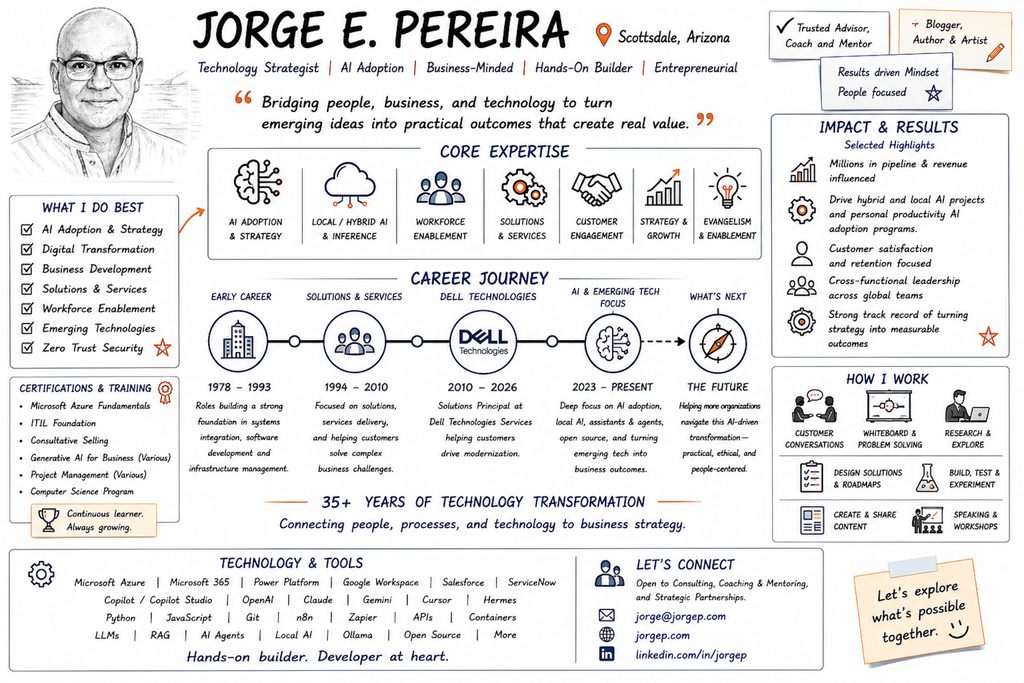
Sometimes a one-page visual helps, so check out my Visual Snapshot below.
Check out my Author Page for my latest books and storybooks
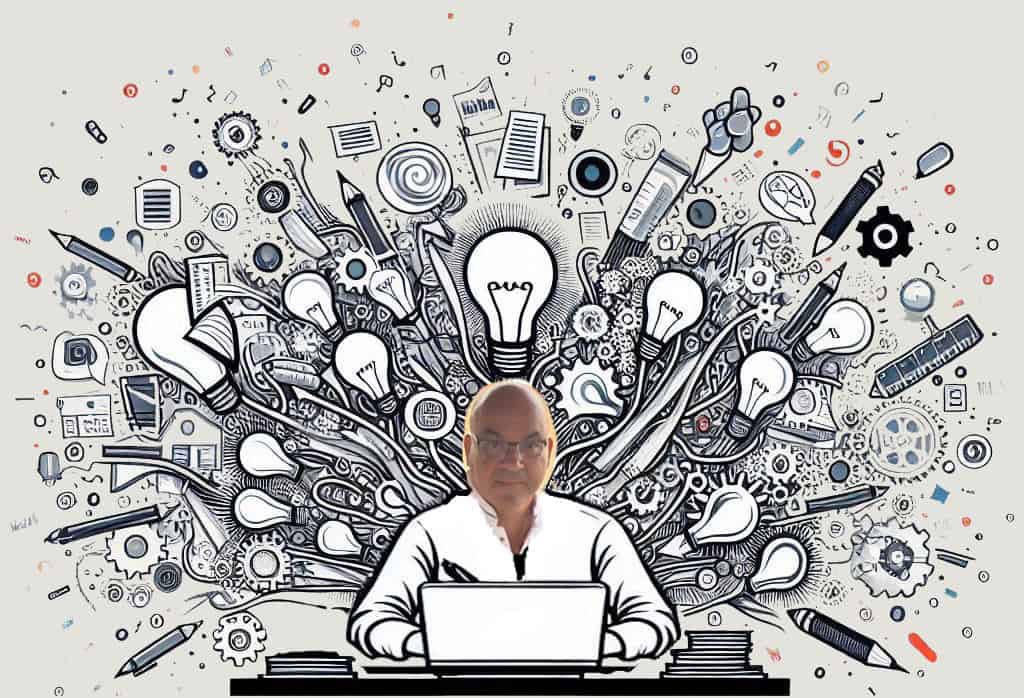

My blog articles can be found at:
| jorgep.com | My primary blog since 2006, where I place everything from random thoughts to article series to things that I’ve found interesting. |
| Books & Stories | Starting in 2024 I began to self-publish some of the story ideas I have been penciling in my mind. Check out this page for more info |
| DoodlingJorge.com | The hub for my creative side – doodling. including my art, merch and learnings blog |
| YouTube Channel | Just started in June 2011 – Never very serious about it but have posted a lot of odds and ends. ( InSeptember 2022 I consolidated my other channel into this one as well. |
| 35Sites.com | 35sites.com provides traditional hosting and WordPress development evolved for the AI era. We also provide Agentic workflow development and practical AI consulting, helping solopreneurs, non-profits, and small businesses leverage open-source technologies to automate operations. |
My Linkedin Profile at: https://www.linkedin.com/in/jorgep
Available for consultation: Website Development (WordPress,Shopify, Etsy), Applicaiton Development, Local AI, Artificial Intelligence (35sites.com)
Just for fun: These are some of the logos and avatars I have used over the years:













Retired Sites
- DayScheduler.com – I used to travel a lot ( 200,000+ miles per year), and I needed a way to keep track of my days. I developed a simple little app that would allow me to show my availability and allow others to request an available day. Launched in 2016 as a way to help keep track requests for my travel schedule. It was rolled out as a SaaS app that helped many users do the same! – — End up closing it on November 2023 as business travel is still limited and much less after the pandemic. – Archived here
- moderneuc.com Launched in 2018, it is a blog about all things Modern Device Management, Modern Desktop. Lots of great info on this new paradigm shift. – In September 2022 I folded that site into a section of Jorgep.com
- enterprisal.com Enterprisal LLC was a business vehicle where I offered some of my development projects / products. Retired on April 2020.
- InfraOps .com – Liked the name so I bought it and later sold it. 2019
- 35notes.com – a web-based application for taking and linking notes. Retired 2015
- ConnectRelate.com – A card-base info tracking and link app. (neural networks!) Retired 2010
- 35posts.com – A social media scheduler web application Retired December 2008.
- pptexchange.com — back in the day (circa 2004) an idea we had – which was later executed brilliantly by SlideShare.net (congrats!)