New Category – Specialized AI Coworkers

The “agentic” era has officially arrived. For the last year, we’ve watched a wave of AI tools—from Claude’s Computer Use to power-user frameworks like Agent Zero and persistent learners like Hermes—promise to handle our digital labor.
But as the space gets crowded, one thing is becoming clear: “AI Agent” is not a one-size-fits-all term.
We are moving away from monolithic tools and into an ecosystem of specialization. Some agents act as autonomous engineers, others as evolving learners, and some as desktop-native coworkers. This brings us to the latest release from Andrew Ng’s team: OpenWorker.
The “Last Mile” Problem
Most AI tools today are still glorified search engines. They give you the answer, but they leave you to do the “last mile” of the work: copy-pasting the output, reformatting the report, or manually clicking through Jira and Slack to update the status.
OpenWorker isn’t built to be an autonomous engineer or an experimental learner. It is built to be a desktop-native coworker. It’s designed to sit on your machine, respect your privacy, and handle the mundane but necessary tasks that clutter our daily calendars and inboxes.
Why OpenWorker Fits In
When you look at the current agent landscape, each tool solves a different friction point:
- For Complex Orchestration: Tools like Agent Zero excel at technical, system-level automation, often utilizing Dockerized environments to solve complex, multi-step engineering tasks.
- For Continuous Evolution: Hermes is carving out a niche in memory and self-improvement, focusing on how an agent can grow and build new skills based on your ongoing preferences.
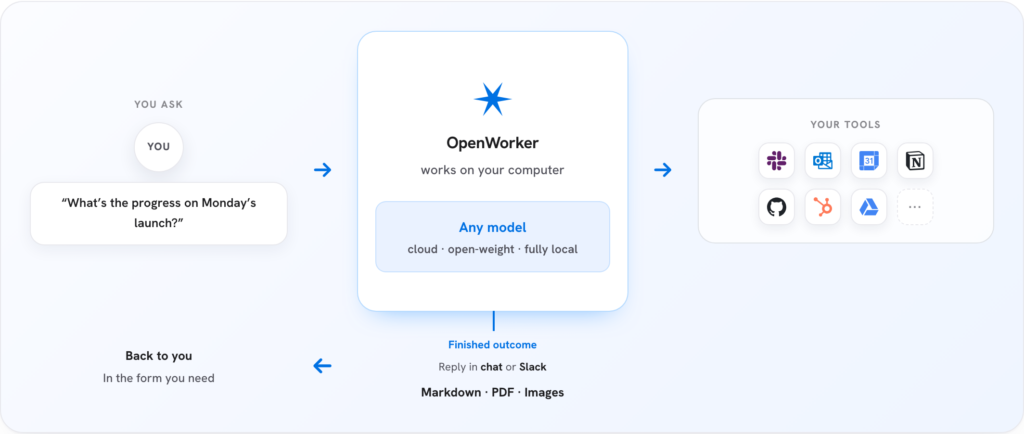
- For Human-in-the-Loop Productivity: OpenWorker fills the gap for the everyday professional. It’s an integration-first assistant that keeps you in command. It doesn’t just “do things” in the background; it acts as an extension of your existing workflow, connecting your tools (Jira, Slack, Notion, GitHub) while ensuring you hold the ultimate authority via strict, tool-level permission enforcement.
The OpenWorker Distinction: Privacy and Choice
What makes OpenWorker particularly compelling for power users is its philosophy on the agent-user relationship:
- Bring Your Own Everything: You aren’t locked into a proprietary model provider. Whether you want the reasoning power of Claude/GPT-4o or the private, sovereign performance of a model running locally via Ollama, the choice is yours.
- Privacy-First Desktop Loop: Unlike many agents that broadcast your data through a cloud-based broker, OpenWorker keeps your conversation history and agent loop local. The only cloud-based element is a minimal service for OAuth token management.
- Safety as a Hard Stop: In many agentic platforms, safety is a “soft” constraint managed by the prompt. OpenWorker enforces safety at the tool-call level. It stops to ask for your permission before any consequential action, or it parks unattended tasks in an inbox for your review.
The Verdict: Choosing Your Coworker
The era of “talking to AI” is over; we are now in the era of “working alongside AI.”
If you are a builder looking for an internal orchestrator, you’ll look to Agent Zero. If you want an agent that builds memory over months, you’ll look to Hermes. But if you want a reliable—and private—coworker that integrates directly into your daily apps and respects your workflow, OpenWorker is a vital addition to your stack.
It’s time to move past the hype and start choosing the right tool for the job. You can explore the project, check the 25+ integrations, and get started yourself over on the OpenWorker GitHub repository.