I Don’t “Use” AI Anymore. I Work With It.
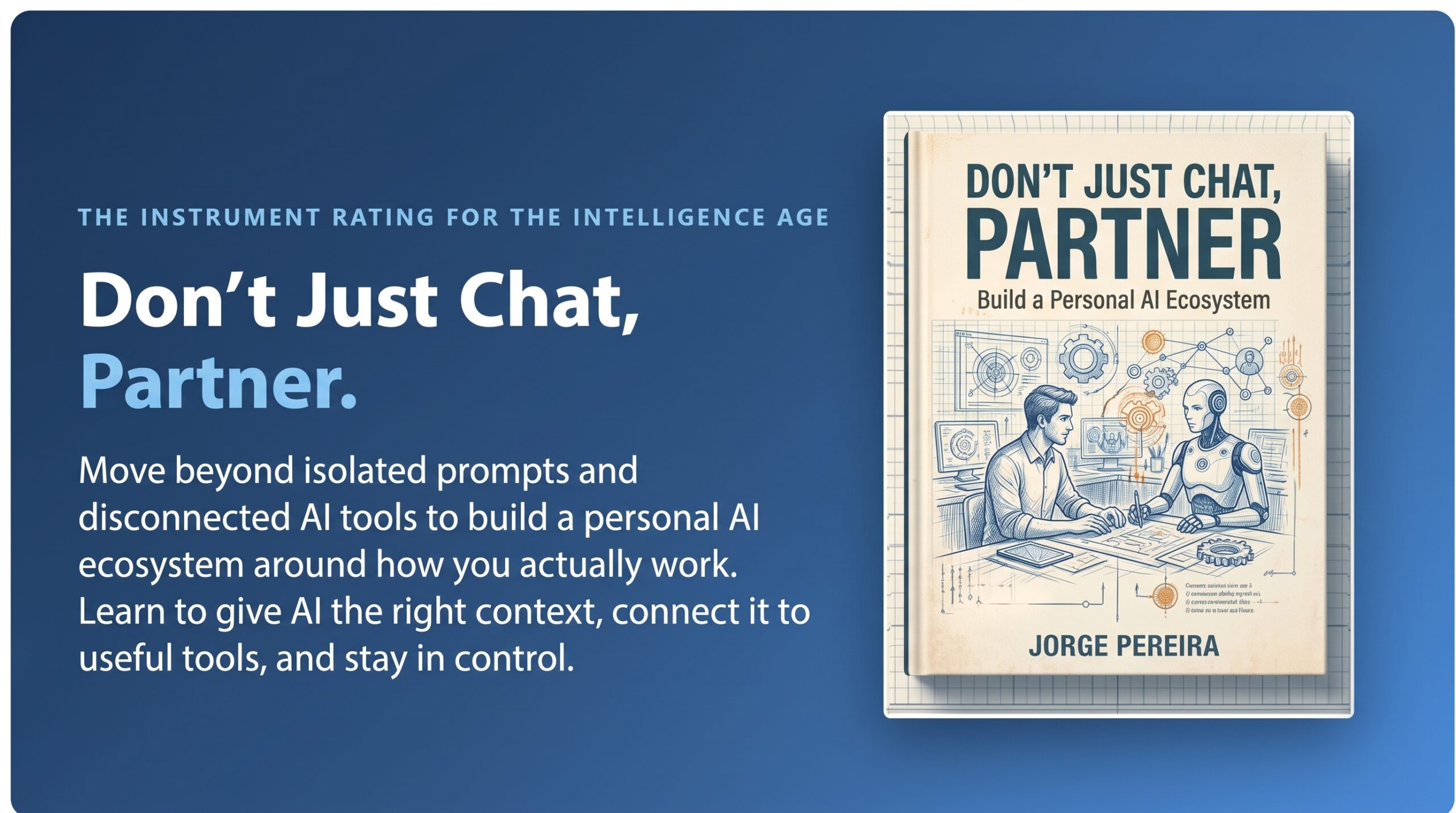
I haven’t been posting much on my blog over the last couple of weeks because I’ve been working on a couple of long-overdue projects. Here is the first of several: my new ebook, Don’t Just Chat, Partner: The Non-Technical Guide to Building Your AI Ecosystem.
This is the third book in the Don’t Just Chat series, and it grew out of a realization about how my own relationship with AI has changed.
I still ask questions. I still delegate tasks. I still build automated workflows.
But increasingly, I’m doing something different.
I’m working with AI.
The Moment Something Changed
One night, while coding, I noticed that I wasn’t simply asking AI to write a function or fix an error.
I was explaining a problem, questioning its suggestions, exploring alternatives, and changing my own thinking along the way. It would propose an approach. I would push back. We would try another direction, test it, and revise.
At some point, I looked at the clock. It was 1:47 a.m.
And something clicked.
I wasn’t asking AI to write code anymore. We were figuring something out together.
AI hadn’t replaced my judgment. It had become part of the process through which I exercised it.
Once I recognized that shift, I started seeing it elsewhere: writing, research, brainstorming, strategy, job searching, and building new projects.
That became the starting point for this book.
Beyond Prompts and Automation
Learning to give AI better instructions is useful. Delegating meaningful work is more useful. Connecting tasks into workflows creates another level of capability.
But automation isn’t always the destination.
There are parts of my work I don’t want to automate away. I want to participate in developing an idea. I want to question a strategy. I want to decide what matters, which opportunities deserve my attention, and what direction a project should take.
In those situations, my presence isn’t the bottleneck. It is part of the value.
The question changes from:
“What can AI do instead of me?”
To:
“What can AI help me do better while I’m fully involved?”
That distinction is at the heart of Don’t Just Chat, Partner.
There’s another piece to this: continuity.
If you use AI regularly, you probably know the routine. You explain the project again. Paste the same background. Repeat your preferences. Remind it that you already considered—and rejected—the approach it just recommended.
I call that the context tax: the effort required to make AI useful before the useful work can begin.
A better working relationship starts somewhere different:
“You know what we’re working on. Let’s continue.”
Your AI Isn’t Just an App
One of the central ideas in the book is that your AI partner isn’t necessarily one chatbot, one model, or one agent.
It is the combination of capabilities you assemble around your work.
Some help you think. Others help you research, write, code, organize, or execute. Files provide knowledge. Project history provides continuity. Tools allow systems to act. Boundaries determine what they may do.
Together, those pieces form a personal AI ecosystem.
That may sound complicated, but it doesn’t have to be. Your starting point could be one AI environment, a clearly defined project, a few useful documents, and a short list of preferences and boundaries.
The goal is not to collect more AI tools.
The goal is to make the tools you choose work better together—and better with you.
Of course, more context should not mean less control. A writing partner may need your previous work and editorial preferences. It doesn’t need your financial accounts. An agent may be allowed to draft a message without being allowed to send it.
Partnership means useful capabilities, clear responsibilities, and trust built through evidence—not a confident-sounding answer.
What’s Inside the Book
The first book, Don’t Just Chat, Delegate, focused on giving AI meaningful work.
The second, Don’t Just Chat, Orchestrate, focused on connecting that work into systems.
Don’t Just Chat, Partner explores how to build an ecosystem that works with you over time.
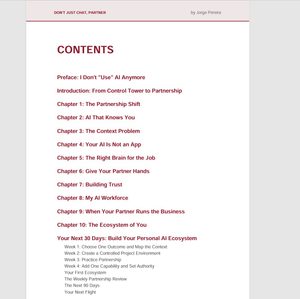
It draws on my own experiences with coding, an AI-assisted job search, agent experiments, and building a community business-directory platform. It turns those experiences into practical frameworks for:
- Choosing when to chat, delegate, orchestrate, or partner.
- Giving AI relevant context without sharing your entire digital life.
- Combining local, cloud, and specialized AI around your needs.
- Connecting tools while setting clear boundaries between preparing work and taking action.
- Building trust gradually, with a 30-day plan for starting your own ecosystem.
It is a nontechnical guide. You don’t need to become an AI engineer or build a miniature data center to begin.
And it is not a guide to creating a digital clone.
I don’t need another Jorge. I need capabilities that extend what Jorge can do.
Take a Look
If AI already helps you complete tasks, the next opportunity may not be another clever prompt or another subscription.
It may be building continuity: helping AI understand your work, consult the right knowledge, use appropriate tools, and recognize when your judgment is needed.
That is the partnership I’m interested in.
Not an AI that replaces me. Not an AI that agrees with everything I say. An ecosystem that helps my experience, curiosity, ideas, and creativity reach further.
Explore Don’t Just Chat, Partner and see what’s inside →
This is the first of those long-overdue projects. More to come.