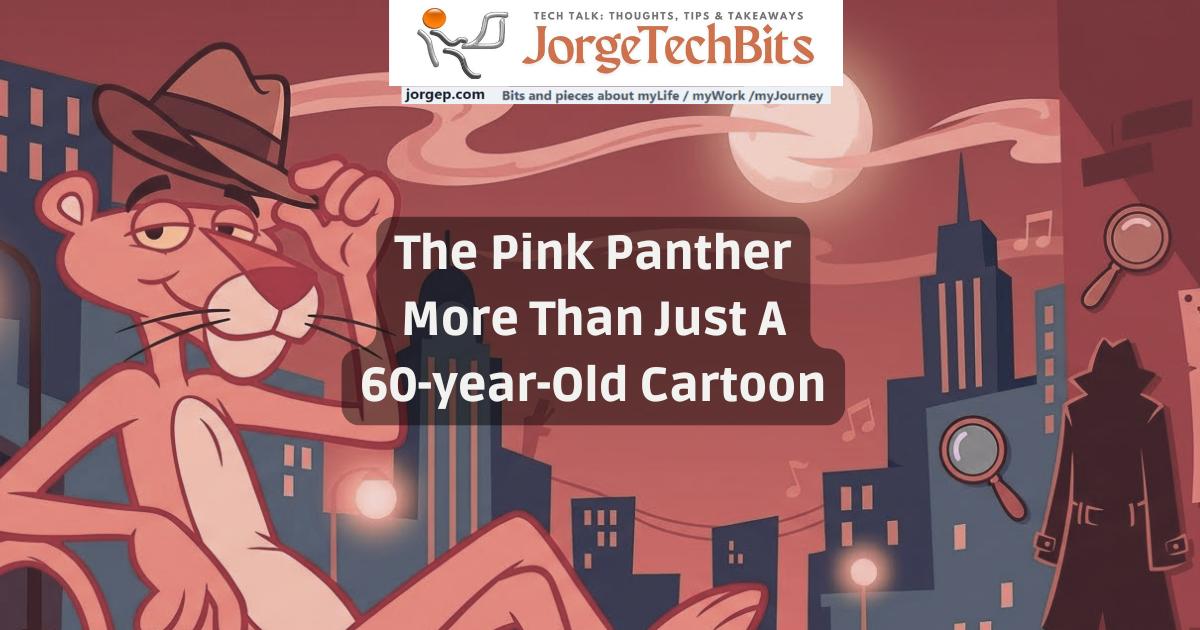
The Pink Panther: 60-Year-Old Cartoon
Part of the Future of Work Series
Disclaimer: I create this content entirely on my own time, and the views expressed here are mine alone (not my employer’s). Because I love leveraging new tech, I use AI tools like Gemini, ChatGPT, Claude, Perplexity and others as a “digital team” to help research and polish these articles so I can share the best possible insights with you!
A practical guide for professionals curious about how entertainment franchises survive—and thrive—across decades – Teaches Us About IP Ownership, Digital Strategy, and the Future of Entertainment
A Confession Before We Begin
Silly me—I know this one sounds a little unusual.
Most of the topics I write about involve technology, business strategy, artificial intelligence, digital transformation, or the future of work.
So why am I writing about the Pink Panther?
Because over the past few weeks, I’ve found myself doing something I never expected: late night binge-watching old Pink Panther cartoons.
What started as a nostalgic trip down memory lane quickly turned into curiosity. I began wondering how a character created more than sixty years ago was still showing up in my YouTube recommendations, still attracting millions of viewers, and still feeling surprisingly relevant.
The more I looked into it, the more fascinating the story became.
What appears to be a simple animated character is actually a masterclass in intellectual property management, brand longevity, media ownership, and digital distribution. The Pink Panther has survived multiple generations of technological change—from movie theaters and broadcast television to streaming platforms and social media.
And perhaps most interesting of all, the character that entertained me as a child is now part of a media portfolio controlled by one of the world’s largest technology companies.
That realization sent me down a rabbit hole. What I discovered wasn’t really a story about a cartoon at all. It’s a story about intellectual property, business strategy, and the future of entertainment.
Let’s dive in.
Why This Matters
At first glance, the Pink Panther might seem like an unlikely subject for a discussion about technology, business strategy, and intellectual property.
But beneath the nostalgia lies a valuable case study in media ownership, brand longevity, and digital distribution.
The Pink Panther has survived more than six decades of industry disruption—from theatrical shorts and broadcast television to streaming platforms and YouTube. Along the way, ownership has changed hands, business models have evolved, and new technologies have transformed how audiences discover content.
For anyone working in business, technology, media, or entrepreneurship, there are lessons worth examining.
How the Pink Panther Was Created
The Pink Panther character first appeared in the opening credits of the 1963 film The Pink Panther.
The animated character was created by animator Friz Freleng and producer David H. DePatie as part of the film’s title sequence. The opening animation proved so popular that the character quickly expanded into theatrical shorts and television programming.
Freleng was already one of animation’s most influential figures. During his career at Warner Bros., he helped shape iconic characters including Bugs Bunny, Daffy Duck, Porky Pig, and Yosemite Sam. After Warner Bros. temporarily shut down its animation division, Freleng partnered with DePatie to form DePatie–Freleng Enterprises, the studio that would build the Pink Panther into a global franchise.
What made the character remarkable was its simplicity: no dialogue, minimal cultural barriers, and a visual style that translated easily across international markets.
That simplicity turned out to be a significant business advantage.
Why Ownership Matters
The Pink Panther is more than a cartoon character. It is intellectual property.
For decades, the franchise existed within the MGM ecosystem through United Artists and related rights arrangements. As with many classic Hollywood properties, the value wasn’t limited to films alone. The character generated revenue through television syndication, licensing, merchandise, home video releases, and later streaming distribution.
A major shift occurred when Amazon acquired MGM in a deal valued at approximately $8.45 billion, which closed in 2022.
That acquisition brought thousands of films and television properties under Amazon’s control, including the Pink Panther franchise.
This transaction illustrates a broader trend that extends well beyond entertainment: technology companies increasingly view intellectual property as a strategic asset.
Streaming services need recognizable content. Recognizable content attracts viewers. Viewers drive subscriptions.
In that environment, established franchises become valuable long-term assets rather than relics of a previous era.
The Digital Reinvention of a Classic Brand
One reason the Pink Panther remains relevant is its successful transition into digital platforms.
The franchise’s official YouTube presence has accumulated more than 13 billion views and nearly 23 million subscribers—an extraordinary achievement for a character created in the early 1960s.
Those numbers demonstrate an important reality about modern media:
Content does not necessarily expire.
When older intellectual property is properly distributed and optimized for contemporary platforms, it can continue generating audience attention decades after its creation.
The lesson extends beyond entertainment.
Whether you’re managing a product, a brand, a content library, or a personal business, distribution matters. Visibility matters. Discoverability matters.
A strong asset without effective digital distribution often fades from public awareness. A well-managed asset can remain relevant indefinitely.
What Amazon’s Strategy Reveals
Amazon did not acquire MGM simply to preserve film history.
The acquisition strengthened Amazon’s ability to compete in streaming and gave the company access to a library of recognizable franchises with built-in audiences.
The Pink Panther represents the kind of intellectual property that large media companies seek:
- High brand recognition
- Global awareness
- Cross-generational appeal
- Licensing opportunities
- Adaptability across formats
In other words, the franchise still has commercial potential.
That potential appears to be influencing future plans. A new Pink Panther film remains in development, and Eddie Murphy has publicly confirmed that he will play Inspector Clouseau.
Whether the project becomes a major success is ultimately less important than what it represents: established intellectual property continues to attract investment when ownership changes and new distribution opportunities emerge.
Three Lessons Professionals Can Take Away
1. Intellectual Property Is a Strategic Asset
The most valuable business assets are not always physical.
Brands, characters, trademarks, copyrights, and creative works can generate value for decades when managed effectively.
2. Distribution Drives Longevity
Great content alone is not enough.
Organizations that adapt to new distribution channels consistently outperform those that rely on legacy audiences.
3. Consolidation Is Reshaping Entertainment
Amazon’s acquisition of MGM reflects a larger shift occurring across media, technology, and communications.
As companies compete for audience attention, ownership of recognizable intellectual property is becoming increasingly important.
Amazing run for a 60-year-old cartoon!
There is something remarkable about the fact that a silent animated character created in 1963 now sits inside the portfolio of a technology company best known for e-commerce, cloud computing, and digital infrastructure.
Yet that reality captures the modern entertainment landscape perfectly.
The Pink Panther is not merely a cartoon character. It is an example of how intellectual property survives technological change, adapts to new platforms, and continues creating value across generations.
Understanding that process isn’t just useful for entertainment executives.
It’s increasingly relevant for anyone building brands, products, media businesses, or digital communities in an economy where attention and intellectual property are among the most valuable assets in the world.
I also wrote a version of this on my personal Substack: Why I Keep Watching the Pink Panther