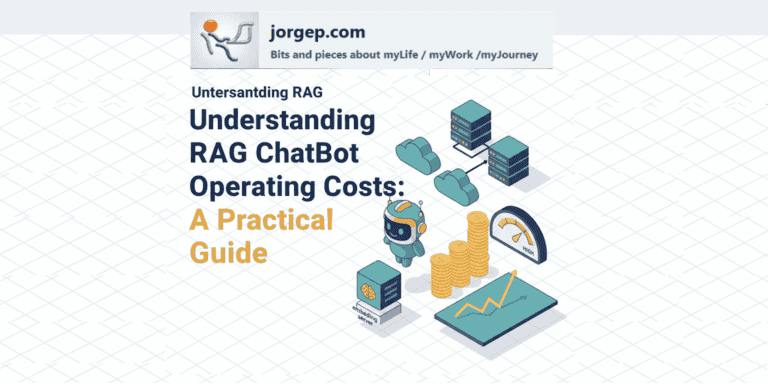
As we move into the new era of the token economy, the conversations, about tokens costs and power are very much part of the story. A useful model must account for real model pricing, utilization, infrastructure, performance, and operational overhead.
Most people start with token pricing because it’s easy to understand and it is the way cloud-based provider bill for their services. But that only captures the cloud side of the equation—and it’s easy to get the economics wrong if you use outdated pricing assumptions.
Modern cloud model pricing varies dramatically by tier. For example,
OpenAI’s GPT‑4o mini is priced at $0.15 / 1M input tokens and $0.60 / 1M output tokens. M
Anthropic’s Claude Opus 4.7 are priced at $5 / 1M input tokens and $25 / 1M output tokens.
On the local side, the biggest driver is often utilization. If your GPU is idle, local AI becomes expensive fast. If it stays busy with steady demand, local AI can be dramatically more cost-effective.
The Two Options to Compare
Your model should compare:
Cloud AI: API-based usage.
Local AI: On-device or on-prem AI running on GPU or CPU hardware.
Across both, measure:
Usage cost
Infrastructure cost
Performance
Governance and security
Operational overhead
High-level comparison
Category
Cloud AI
Local AI
Cost structure
Variable (per token)
Fixed + variable
Scaling
Elastic
Hardware-bound
Latency
Network dependent
Local / predictable
Data control
Provider-managed
Customer-controlled
Predictability
Variable bill
Stable once deployed
Modern AI Pricing Reality (Token Costs Are Not One Number)
The key insight: output tokens often dominate cost for high-intelligence models because output rates can be multiples of input rates.
The Inputs Needed
Workload characteristics (both cloud and local)
Parameter
Description
Requests per day/month
Total demand volume
Input tokens per request
Prompt + context + retrieved text
Output tokens per request
Response length
Peak vs average usage
Drives utilization and sizing
Latency requirements
Real-time vs batch
Model tier
Budget vs premium reasoning
These determine both the total cost and the required compute footprint.
Cloud Cost Drivers (It is all About Tokens!)
Because cloud pricing differs for input vs output tokens, your calculator should split them:
Monthly Cloud Cost =
(Requests × Input Tokens × Input Price per token) +
(Requests × Output Tokens × Output Price per token)
Use current provider pricing for your target models (example: GPT‑4o mini pricing shown in OpenAI’s model docs).
Local Cost Drivers (A bit more complex)
Local AI has more moving parts—this is where ROI can flip quickly at high volume.
Hardware cost (CAPEX)
GPU(s), CPU, RAM, storage
Amortization period (commonly 24–48 months; 36 is a typical baseline for modeling)
Power consumption (OPEX)
Power matters for always-on systems. As a reference point, an NVIDIA L40S has a 350W max power rating, which helps bound GPU draw in your estimate. [techpowerup.com]
Monthly Power Cost =
(Average kW × Hours per month)
× Electricity rate
x PUE
Utilization rate
Utilization is one of the most important variables:
Low utilization often favors cloud
High utilization often favors local
Ops overhead
Include:
DevOps/MLOps time
Monitoring and patching
Model optimization work
Optional licensing costs (if applicable)
KPI Outputs the Calculator Should Show
KPI
Why it matters
Cost per request
Direct business metric
Cost per 1K tokens
Normalized comparison
Break-even volume
Where local equals cloud
TCO (1–3 years)
Long-term economics
ROI %
Investment value
ROI = (Cloud Cost – Local Cost) / Local Cost
USE CASES with Actual Numbers (Cloud vs Local)
The examples below show why “local almost always wins at high volume” is often true when you’re using premium models or have steady utilization. The token pricing used is sourced from vendor documentation for GPT‑4o mini, Claude Opus 4.7, and OpenAI o1.
Assumptions (used for the local examples)
These are modeling assumptions (you can adjust them in your calculator):
Hardware amortization: 36 months
Electricity rate: $0.12/kWh
PUE (datacenter overhead): 1.3
“Average kW” reflects average draw under mixed load; GPU max wattage reference used: L40S 350W max[techpowerup.com]
Use Case 1: Multiuser Internal Workstation for Search + Summarization (RAG)
Local cost example (larger dev-focused inference stack)
A single high-end workstation cannot sustain large-scale enterprise workloads. In our model, one $20K system supports roughly one-third of the total demand, requiring three systems to meet full load. Even with this adjustment, local AI remains significantly more cost-effective than cloud at high volume.
Example local stack sizing (illustrative):
Hardware CAPEX: $20,000
RAM Memory: 256 GB
Amortization: 36 months
Average power: 2.8 kW
Ops: $150/month
Component
Monthly Cost
Hardware amortization
$20,000 ÷ 36 = $555.56
Power (incl. PUE)
2.8kW × 720h × $0.12 × 1.3 = $314.50
Ops overhead
$150
Total local
$1,020.06 x 3 systems – $3,060.00
Cost per request
$1,020.06 ÷ 480K = $0.00213
Takeaway (Developer): For high-volume developer workflows using a heavy reasoning model like o1, cloud costs can scale sharply because both input and output are priced at premium rates. In this example, local delivers a materially lower cost per request once steady demand and utilization justify the fixed platform cost. [cloudprice.net]
Why Local Wins “At High Volume” (When It Does)
Local AI tends to win economically when:
You use premium models with high per-token rates (Opus/o1 class).
Your workload is steady enough to keep hardware utilization high.
You can share the same local inference stack across multiple teams/workloads.
Cloud can still win when:
Most traffic can be routed to budget models (e.g., GPT‑4o mini).
Demand is bursty and unpredictable.
You want to avoid operational overhead.
Local AI Hardware Comparison (dor your reference)
To run a local-first enterprise, you need hardware that can handle large models with high throughput. The table below combines specialized Blackwell systems, Mac workstations, and the rising AMD Ryzen ecosystem.
PRICES Change daily so thiese are provided here as of the date of this writing for reference only
Model
Capacity
Capability
Efficiency & Best Use
MacBook Pro (M4 Max)
Up to 128GB Unified Memory
Runs models up to 70B-120B parameters natively. (Est. Price: $4,200 – $5,500)
The Mobile Office: Best for on-the-go agent development and privacy-centric local testing.
Ryzen AI Max+ 395 (Strix Halo)
Up to 128GB Unified Memory
Can host 70B models natively using iGPU offloading. (Est. Price: $2,500 – $4,000)
The Studio Killer: Delivers “Mac Studio” unified memory performance on an open x86 platform.
GB10 Grace Blackwell
128GB Unified Memory
Can run models up to 200B parameters locally. (Est. Price: $3,000 – $5,000)
The Pro Team Standard: Low power draw (~150W) for a 10-person agency.
Mac Studio (M4 Ultra)
Up to 275GB Unified Memory
Efficiently serves high-concurrency 70B models for a small team. (Est. Price: $6,500 – $9,000)
The Silent Workstation: Exceptional performance-per-watt; fits easily into a standard office setup.
Radeon PRO W7900
48GB GDDR6 VRAM
Runs 70B models at high throughput with full ROCm support. (Est. Price: $3,500 – $4,200)
The Enterprise Value: The professional 48GB alternative to NVIDIA for teams on a budget.
GB300 Blackwell Ultra
748GB Coherent Memory
Can host trillion-parameter models. (Est. Price: $35,000 – $50,000)
The Powerhouse: Designed for heavy-duty, autonomous inference loops.
AMD Threadripper PRO 7995WX
Up to 2TB DDR5 RDIMM
Massive-scale multi-agent training and trillion-parameter clusters. (Est. Price: $10,000+)
The Data Center at Home: For agencies running entire local server fleets from one box.
Hardware Selection Strategy for Your Team
For the Individual Developer: The MacBook Pro with M-series Max chips is the gold standard for individual agent prototyping, allowing you to carry a “miniature LLM server” anywhere.
For the 6-10 Person Team: The GB10 or a Mac Studio serves as the perfect central hub. They provide enough memory to run high-reasoning models while remaining quiet and cool enough for a collaborative workspace.
For Full Autonomy: If you are deploying dozens of agents to manage your WordPress fleet simultaneously, the GB300 provides the massive memory bandwidth required to prevent bottlenecks during peak usage.