

Demystifying Zero Trust and SASE
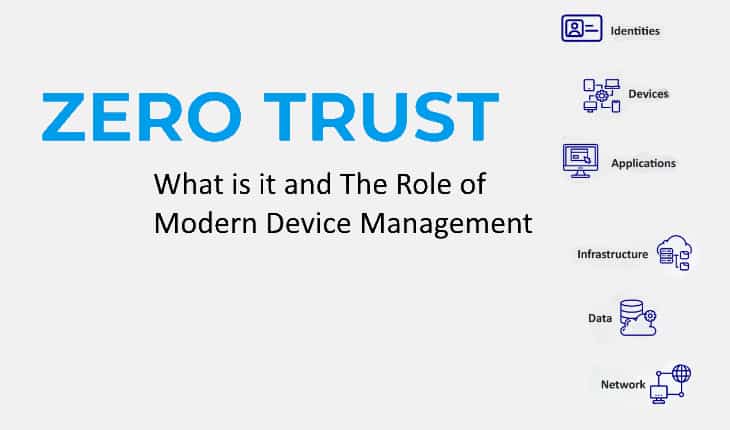
In today’s digital landscape, the traditional corporate perimeter is officially dead. Workforces are hybrid, critical workloads live in the cloud, and sensitive data moves seamlessly between SaaS applications, personal devices, and edge environments.
The Blueprint for Modern Cybersecurity
For security and IT teams, this shift has rendered legacy defenses—like centralized VPNs and corporate “castle-and-moat” firewalls—obsolete. To protect modern infrastructure without frustrating users, two core concepts have emerged as the foundation of modern enterprise security: Zero Trust and SASE (Secure Access Service Edge).
While these terms are often used interchangeably in vendor pitch decks, they are distinct concepts that work together. Here is a breakdown of what they mean, how they differ, and why combining them is essential for modern cybersecurity.
1. Zero Trust: The Security Strategy
Zero Trust is not a specific software product or hardware appliance—it is a strategic security philosophy.
Historically, network security relied on implicit trust. Once a user or device passed the perimeter boundary (like logging into the office Wi-Fi or connecting via VPN), they were implicitly trusted to access resources inside the network. Zero Trust flips this paradigm on its head with a simple core rule: “Never trust, always verify.”
The Key Pillars of Zero Trust:
- Verify Explicitly: Always authenticate and authorize based on all available data points—including user identity, location, device health, time of day, and application context.
- Use Least-Privilege Access: Limit access strictly to what a user needs right now. Instead of granting wide access to a network segment, users receive granular access to specific applications using principles like Just-In-Time (JIT) access.
- Assume Breach: Design defenses with the assumption that bad actors are already inside the network. Micro-segment environments to prevent lateral movement, encrypt all traffic end-to-end, and continuously monitor session activity.
2. SASE: The Delivery Architecture
If Zero Trust is the strategy, SASE (Secure Access Service Edge) is the architecture that executes it.
Coined by Gartner, SASE (pronounced “sassy”) unifies enterprise networking and advanced security functions into a single, cloud-native service platform delivered at the edge.
Instead of forcing traffic from remote workers or branch offices to route back through a central corporate data center for security inspection (creating latency and bottlenecks), SASE brings security enforcement directly to the point of connection—wherever the user happens to be.
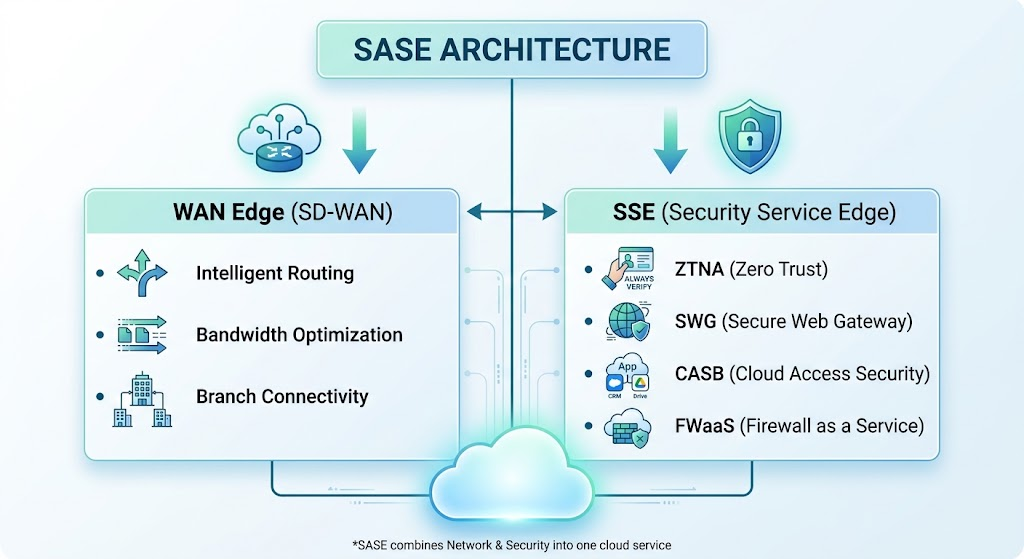
The Dual Engine of SASE:
- Network Capabilities (WAN Edge): Leverages SD-WAN (Software-Defined Wide Area Network) to route network traffic dynamically based on quality, priority, and security requirements.
- Security Capabilities (Security Service Edge / SSE): Consolidates multiple security functions into one cloud stack:
- Zero Trust Network Access (ZTNA): Replaces legacy VPNs by granting explicit access to individual applications without exposing the rest of the network.
- Secure Web Gateway (SWG): Inspects web traffic to block malware and enforce URL policies.
- Cloud Access Security Broker (CASB): Secures and governs cloud services (like Microsoft 365, Google Workspace, or Salesforce).
- Firewall as a Service (FWaaS): Provides next-gen firewall protection from the cloud edge.
How Zero Trust and SASE Work Together
To understand the relationship between the two, think of Zero Trust as the rules of the road and SASE as the highway infrastructure.
| Dimension | Zero Trust | SASE |
| Primary Focus | Security mindset, identity, and access control policies. | Cloud-native network routing and security convergence. |
| Role | The Strategy: Defines how access decisions should be evaluated. | The Engine: Provides the infrastructure to execute those policies everywhere. |
| Core Goal | Eliminate implicit trust and reduce attack surface area. | Deliver seamless, low-latency performance and security globally. |
When paired, SASE acts as the vehicle through which Zero Trust policies are consistently enforced across every branch office, mobile device, remote employee, and cloud resource in real time.
Business Benefits of a SASE + Zero Trust Model
Adopting a unified SASE and Zero Trust architecture delivers immediate operational and strategic advantages:
- Seamless User Experience: Eliminates the latency associated with VPN backhauling, granting remote employees fast, direct access to the applications they need.
- Reduced Complexity & Cost: Replaces disparate point solutions (firewalls, standalone web filters, separate VPN gateways) with a consolidated, cloud-managed platform.
- Enhanced Threat Protection: Continuous, identity-driven inspection helps stop ransomware, phishing, and unauthorized data exfiltration before threats can spread laterally.
- Scalable Flexibility: Enables IT teams to onboard new branch offices or remote employees in minutes rather than weeks.
Final Thoughts
Securing the modern enterprise isn’t about building higher walls around a static perimeter; it’s about establishing intelligent, dynamic security at every edge. By combining the governance philosophy of Zero Trust with the cloud-native infrastructure of SASE, organizations can protect their critical assets while keeping their workforce agile, efficient, and productive.