Understanding Modern Processing Units: CPU, GPU, NPU, and LPU

To learn more about Local AI topics, check out related posts in the Local AI Series
Have questions, ideas to share, or just want to connect? I’d love to hear from you! Check out my About Page to learn more about me or connect with me.
Part of: AI Learning Series Here
Quick Links: Resources for Learning AI | Keep up with AI | List of AI Tools | Local AI | AI Agents | Future of Work
Subscribe to JorgeTechBits newsletter
Explore the Latest Token Prices

Disclaimer: I create this content entirely on my own time, and the views expressed here are mine alone (not my employer’s). Because I love leveraging new tech, I use AI tools like Gemini, ChatGPT, Claude, Perplexity and others as a “digital team” to help research and polish these articles so I can share the best possible insights with you!
See Also: AI on the PC: A New Era in Personal Computing and Local AI Series
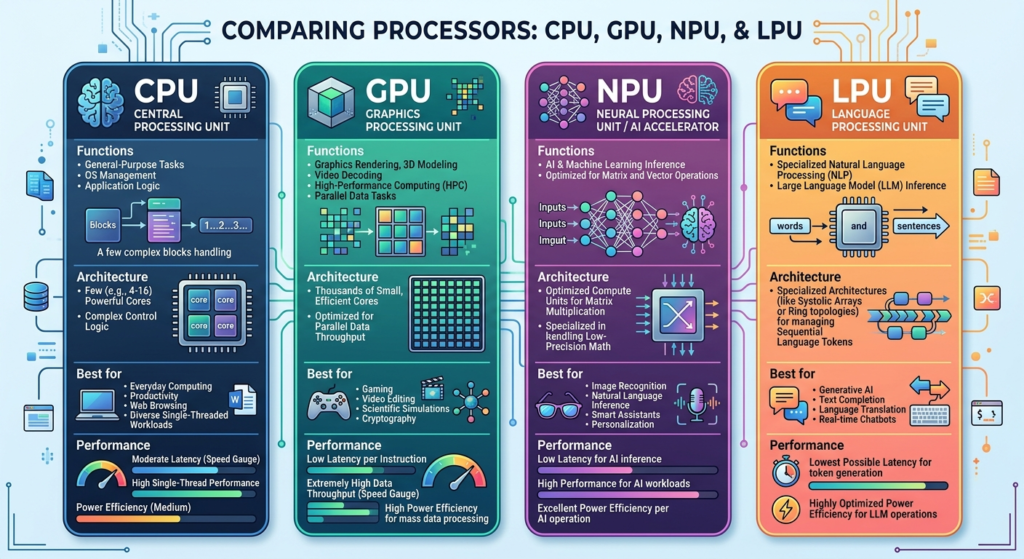
In the ever-evolving landscape of technology, various processing units are at the heart of our devices. Understanding these components helps us appreciate their unique capabilities and the specific tasks they’re built to handle. This article explores CPUs, GPUs, NPUs, and LPUs, examining their architectures, strengths, and applications.
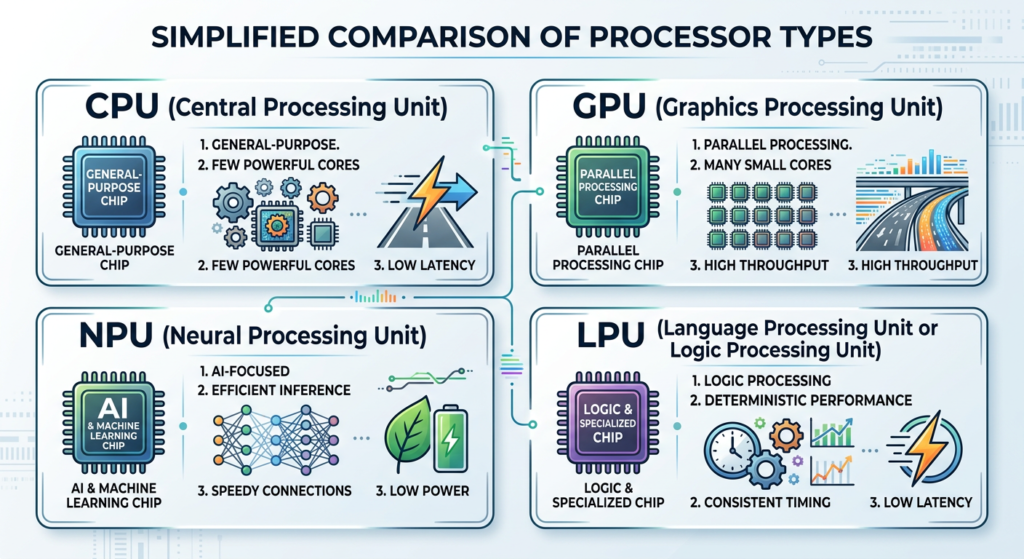
CPU (Central Processing Unit)
The Central Processing Unit (CPU) is often called the “brain” of the computer. It executes the instructions of a program and handles the core logic of every computing operation, from simple arithmetic to complex system management.
Architecture and Functionality
CPUs typically feature a relatively small number of cores (4–64) with deep instruction pipelines and large caches. They are optimized for sequential processing, meaning they handle one or a few tasks at a time with exceptional speed per thread. Modern CPUs use techniques like branch prediction, out-of-order execution, and speculative execution to maximize performance.
Key Characteristics
- General-purpose: Can run virtually any program or operating system.
- Low latency: Excellent at responding quickly to single tasks.
- Control hub: Manages system resources, peripherals, and memory allocation.
Common Applications
- Operating systems and general computing
- Web browsing, office applications, and productivity software
- Database management and transaction processing
- Running business applications and servers
GPU (Graphics Processing Unit)
The Graphics Processing Unit (GPU) was originally designed to accelerate graphics rendering. Today, it has evolved into a massively parallel processor capable of handling a vast range of computational workloads, especially those that benefit from doing many calculations simultaneously.
Architecture and Functionality
GPUs contain thousands of small cores organized into streaming multiprocessors. This architecture is optimized for throughput — performing a huge volume of operations across many threads, even if each individual operation is slower than what a CPU might do.
Key Characteristics
- Massive parallelism: Can handle thousands of threads concurrently.
- High memory bandwidth: Features wide memory buses optimized for streaming data.
- Throughput-optimized: Best at doing many similar tasks at once.
Common Applications
- Gaming and 3D rendering
- Video editing and color grading
- Scientific simulations and research
- Cryptography and cryptocurrency mining
- Training large AI models (e.g., deep learning)
NPU (Neural Processing Unit)
The Neural Processing Unit (NPU) is a specialized processor designed to accelerate machine learning and AI workloads, particularly inference — running already-trained neural networks on new data.
Architecture and Functionality
NPUs are built around the matrix multiplication and convolution operations that dominate neural network computations. They typically use low-precision arithmetic (INT8, INT4, FP16) to achieve fast, energy-efficient AI execution, often featuring dedicated MAC (Multiply-Accumulate) arrays.
Key Characteristics
- AI-specific: Designed for tensor operations, convolutions, and activations.
- Energy-efficient inference: Performs AI tasks with minimal power draw.
- Often integrated: Frequently embedded into SoCs (System on Chip) alongside CPUs and GPUs.
Common Applications
- Real-time language translation
- Voice assistants and speech recognition
- Face detection and image classification
- Generative AI on-device (image and text generation)
- Smart camera processing
LPU (Logic / Language Processing Unit)
The LPU (Logic Processing Unit) is an emerging category that can refer to two distinct but related concepts:
- Logic Processing Unit: A chip optimized for handling discrete, deterministic logic operations, often used in networking and signal processing.
- Language Processing Unit: A new class of accelerator specifically designed to handle large language model (LLM) inference faster and more efficiently than GPUs. Groq’s LPU is the most well-known example.
Groq’s LPU Inference Engine, for instance, is engineered for sequential, deterministic processing of language model tokens, delivering low-latency, predictable inference for LLMs.
Key Characteristics
- Deterministic performance: Predictable timing — crucial for real-time AI.
- Optimized for autoregressive workloads: Excellent for text generation where each token depends on the previous one.
- High throughput per watt: Designed for efficient LLM serving at scale.
Common Applications
- Real-time conversational AI and chatbots
- LLM inference at scale (serving models like Llama, Mixtral, etc.)
- Code completion tools
- Edge AI and on-device language processing
Detailed Graphic:
Other Notable Processing Units
Beyond the main four, several other specialized processors play important roles:
| Unit | Full Name | Primary Function |
|---|---|---|
| TPU | Tensor Processing Unit | Google’s custom ASIC for accelerating machine learning workloads, particularly TensorFlow-based training and inference. |
| DSP | Digital Signal Processor | Specialized for real-time signal processing, used in audio, telecommunications, and sensor data. |
| FPGA | Field-Programmable Gate Array | Customizable hardware that can be reprogrammed post-manufacturing for specialized tasks. |
| ASIC | Application-Specific Integrated Circuit | Custom-built chips designed for one specific task, offering maximum efficiency. |
| VPU | Vision Processing Unit | Designed for computer vision tasks like object detection and tracking. |
Summary Comparison Table
| Feature | CPU | GPU | NPU | LPU |
|---|---|---|---|---|
| Full Name | Central Processing Unit | Graphics Processing Unit | Neural Processing Unit | Language/Logic Processing Unit |
| Primary Strength | Versatility & control | Parallel throughput | AI inference efficiency | Low-latency LLM serving |
| Architecture | Few powerful cores | Thousands of small cores | MAC arrays, low-precision | Deterministic sequential pipeline |
| Best For | General-purpose tasks | Graphics & parallel compute | Neural network inference | Real-time language models |
| Typical Latency | Very low | Moderate | Low | Ultra-low & predictable |
| Power Efficiency | Moderate | High power draw | Very high | High |
| Core Count | 4–64 | 1,000s | Tens to hundreds (MAC units) | Varies (often many simple units) |
| Common Device | Every computer/phone | Gaming PCs, data centers | Smartphones, AI PCs | AI servers, cloud platforms |
| Key Example | Intel Core i9 | NVIDIA RTX 4090 | Apple Neural Engine, Qualcomm Hexagon | Groq LPU Inference Engine |
| Year Emerged | 1970s | 1990s | 2010s | 2020s |
Added on 2025-06-22:
When Did NPUs Come to Market?
Based on the search results and industry history, NPUs (Neural Processing Units) made their market debut in two distinct phases: as discrete chips around 2018, and as integrated consumer components starting in 2023.
Here is the breakdown of their market entry:
1. First Discrete NPUs (The “Pro” Era)
The first dedicated NPU chips were released for industrial and IoT applications, not for daily consumer use.
- 2018: Intel released the Myriad X (part of the Movidius acquisition), which was the industry’s first commercially available NPU 1. It was a discrete SoC (System on Chip) focused on IoT, drones, and security cameras using deep learning-based methods.
- 2019–2020: Follow-on chips like King Bay appeared, continuing to focus on IoT and computer vision workloads.
2. First Integrated Consumer NPUs (The “AI PC” Era)
This is the phase where NPUs became a standard feature in laptops, smartphones, and cars, allowing for on-device AI.
- Later 2023: AMD entered the consumer NPU market with the Ryzen 7040 series (Zen 4 architecture), featuring integrated XDNA NPUs delivering 10 TOPS (trillion operations per second).
- December 2023: Intel launched Meteor Lake (Core Ultra processors), introducing their first consumer NPUs (Intel AI Boost) for laptops with 13 TOPS performance.
- 2024: Qualcomm launched the Snapdragon X Elite with a 45 TOPS NPU, designed to meet Microsoft’s Copilot+ PC requirements.
- 2025: By this year, NPUs became standard in premium smartphones, laptops, and emerging automotive systems. For example, in March 2025, NXP introduced the S32K5 microcontroller for the automotive industry with an embedded NPU.
Summary Timeline
|
Year |
Milestone |
Key Players |
Use Case |
|---|---|---|---|
|
2018 |
First discrete NPU launched |
Intel (Myriad X) |
IoT, drones, security cameras |
|
2019–2020 |
Continued IoT-focused NPU development |
Various vendors |
Computer vision workloads |
|
Late 2023 |
First consumer-integrated NPUs in laptops |
AMD (Ryzen 7040, 10 TOPS), Intel (Meteor Lake, 13 TOPS) |
AI PC revolution begins |
|
2024 |
High-performance NPUs for Copilot+ PCs |
Qualcomm (Snapdragon X Elite, 45 TOPS) |
On-device AI in mainstream laptops |
|
2025 |
NPUs become standard in premium devices |
Apple, Qualcomm, Intel, AMD, NXP |
Smartphones, laptops, automotive systems |
x
Which Processor Should You Care About?
- For everyday use: Your CPU is doing most of the heavy lifting.
- For gaming or creative work: Your GPU matters most.
- For AI-powered features on your phone or PC: The NPU is increasingly important.
- For AI developers and businesses serving LLMs: LPUs and TPUs are becoming game-changers.
[Generated by: minimax/minimax-m3]
When Did NPUs Come to Market?
Based on the search results and industry history, NPUs (Neural Processing Units) made their market debut in two distinct phases: as discrete chips around 2018, and as integrated consumer components starting in 2023.
Here is the breakdown of their market entry:
1. First Discrete NPUs (The “Pro” Era)
The first dedicated NPU chips were released for industrial and IoT applications, not for daily consumer use.
- 2018: Intel released the Myriad X (part of the Movidius acquisition), which was the industry’s first commercially available NPU 1. It was a discrete SoC (System on Chip) focused on IoT, drones, and security cameras using deep learning-based methods.
- 2019–2020: Follow-on chips like King Bay appeared, continuing to focus on IoT and computer vision workloads.
2. First Integrated Consumer NPUs (The “AI PC” Era)
This is the phase where NPUs became a standard feature in laptops, smartphones, and cars, allowing for on-device AI.
- Later 2023: AMD entered the consumer NPU market with the Ryzen 7040 series (Zen 4 architecture), featuring integrated XDNA NPUs delivering 10 TOPS (trillion operations per second).
- December 2023: Intel launched Meteor Lake (Core Ultra processors), introducing their first consumer NPUs (Intel AI Boost) for laptops with 13 TOPS performance.
- 2024: Qualcomm launched the Snapdragon X Elite with a 45 TOPS NPU, designed to meet Microsoft’s Copilot+ PC requirements.
- 2025: By this year, NPUs became standard in premium smartphones, laptops, and emerging automotive systems. For example, in March 2025, NXP introduced the S32K5 microcontroller for the automotive industry with an embedded NPU.
Summary Timeline
| Year | Milestone | Key Players | Use Case |
|---|---|---|---|
| 2018 | First discrete NPU launched | Intel (Myriad X) | IoT, drones, security cameras |
| 2019–2020 | Continued IoT-focused NPU development | Various vendors | Computer vision workloads |
| Late 2023 | First consumer-integrated NPUs in laptops | AMD (Ryzen 7040, 10 TOPS), Intel (Meteor Lake, 13 TOPS) | AI PC revolution begins |
| 2024 | High-performance NPUs for Copilot+ PCs | Qualcomm (Snapdragon X Elite, 45 TOPS) | On-device AI in mainstream laptops |
| 2025 | NPUs become standard in premium devices | Apple, Qualcomm, Intel, AMD, NXP | Smartphones, laptops, automotive systems |
While specialized NPU chips existed since 2018, they were confined to industrial applications. The real consumer breakthrough came in late 2023, when NPUs began appearing in everyday laptops and smartphones, enabling on-device AI without relying on the cloud.
The computing landscape is no longer dominated by a single type of processor. Each unit — CPU, GPU, NPU, LPU — has evolved to handle specific workloads with remarkable efficiency. As AI workloads grow and specialized computing demands increase, expect even more diversity in processing architectures. The future of computing is heterogeneous, meaning systems will increasingly combine multiple types of processors working in harmony to deliver the best performance for each task.