Understanding LLM Mixture of Experts (MoE)
To learn more about Local AI topics, check out related posts in the Local AI Series
Part of: AI Learning Series Here
Quick Links: Resources for Learning AI | Keep up with AI | List of AI Tools | Local AI | AI Agents | Future of Work
Subscribe to JorgeTechBits newsletter
To learn more about Local AI topics, check out related posts in the Local AI Series
Disclaimer: I create this content entirely on my own time, and the views expressed here are mine alone (not my employer’s). Because I love leveraging new tech, I use AI tools like Gemini, NotebookLM, Claude, Perplexity and others as a “digital team” to help research and polish these articles so I can share the best possible insights with you!
When you hear about the latest large language models (LLMs)—like GPT-4, Claude, or Gemini—it’s easy to feel overwhelmed by their sheer scale. These models contain billions, sometimes trillions, of parameters.
This incredible size is what gives them their broad capabilities—from writing code and summarizing texts to answering complex questions and creating poetry. But that scale comes with a cost: massive computational requirements. Training or running such large models demands enormous processing power, making them slow and expensive to operate at scale.
The AI industry needed a way to achieve the performance of huge models without the crushing computational cost. Enter the Mixture of Experts (MoE) architecture.
What Is Mixture of Experts (MoE)?
Mixture of Experts is an architectural approach that enables LLMs to be larger and more powerful while staying computationally efficient and fast.
Think of a traditional model as a single, brilliant generalist who has to handle every question—whether it’s about physics or poetry—using all their knowledge at once.
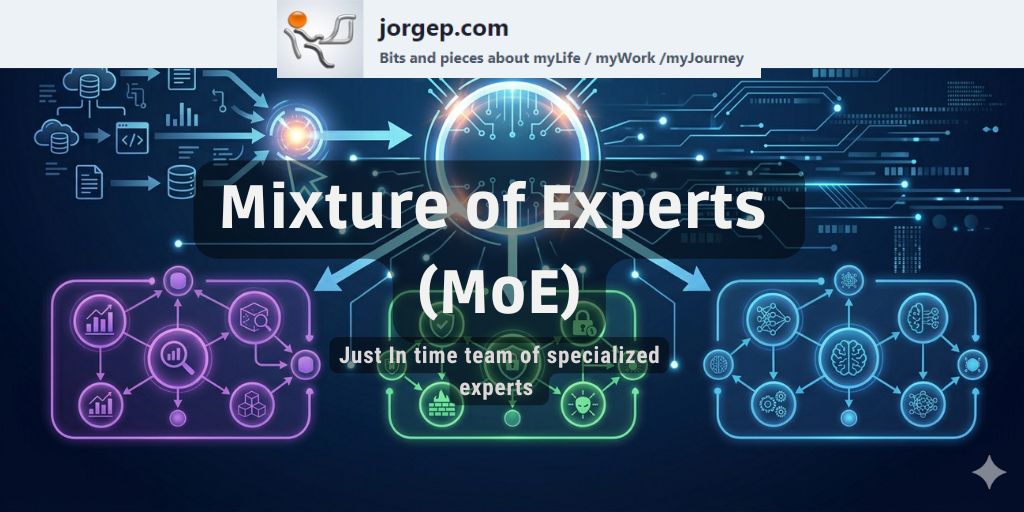
By contrast, MoE is like assembling a team of specialized experts. The model is divided into smaller, specialized components called Experts. When a new question arrives, a control mechanism known as the Router determines which subset of experts (for example, two or four) are best suited to handle that specific input.
Only those selected experts are activated, while the rest remain idle—saving time and resources.
The University Panel Analogy
Imagine you bring a complex consulting problem to two different firms:
- Traditional LLM: A single, massive firm analyzes your problem using every department—finance, legal, science, and marketing—whether relevant or not. It’s thorough but slow and costly.
- MoE Model: A router reviews your issue and instantly decides it’s a legal and finance problem. Only those departments are activated, collaborating efficiently while others stay inactive.
This is how MoE achieves specialization and speed—by activating only the expertise that matters.
How MoE Works: The Technical Flow
The Mixture of Experts framework includes three key components:
- The Experts — The Knowledge Base
Independent sub-networks trained for specific domains, such as code generation, reasoning, or conversational tone. Each expert specializes in a particular slice of knowledge. - The Router — The Gatekeeper
A control layer that inspects incoming prompts. It determines which experts are most relevant based on the input’s intent and content, then activates them selectively. - The Mixture — The Synthesis
The selected experts process the input separately. Their outputs are then blended, or “mixed,” into a single unified response—ensuring both depth and coherence.
Why Mixture of Experts Matters
MoE isn’t merely a clever efficiency hack—it represents a structural breakthrough that transforms how large-scale AI operates. Its key benefits include:
Because only a portion of the network activates at any given time, engineers can build much larger models overall without proportional increases in computational cost. In other words, MoE architectures make it possible to scale up total model size while keeping real-time operations lightweight and efficient.
1. Efficiency (Lower Cost, Faster Speed) – Only a small subset of parameters is activated for any given query. This selective computation dramatically reduces processing load (FLOPs), lowering both time and cost. Result: Faster, cheaper responses compared to dense models of similar total size.
2. Scalability (More Parameters, Less Pain) – MoE models can contain hundreds of billions of parameters overall, yet only use a fraction of them per query. Result: Massive knowledge capacity without proportional increases in compute expense. –
3. Specialization (Deeper, Better Knowledge) – By segmenting expertise across distinct experts, MoE models develop specialized strengths. Result: Higher accuracy, adaptability, and nuanced reasoning compared to monolithic, dense models.
Mixture of Experts (MoE) models originated in 1991.
The concept was first introduced in the seminal paper “Adaptive Mixtures of Local Expert Networks” by Robert Jacobs, Michael Jordan, Geoffrey Hinton, and others. This early work proposed using multiple specialized “expert” networks with a gating mechanism to divide tasks efficiently—laying the foundation for modern MoE architectures.
Key Milestones
- Early 1990s: Academic roots in conditional computation, with Hinton’s team exploring ensemble-like networks.
- 2017: Noam Shazeer (with Hinton and Jeff Dean at Google) scaled MoE to a 137B-parameter LSTM model using sparse gating, marking practical NLP application.
- 2021: Google’s Switch Transformer pushed to 1.6 trillion parameters, proving MoE’s scalability for transformers.
MoE remained mostly theoretical for decades due to training challenges but exploded in popularity around 2023-2024 with models like Mixtral and DeepSeek, powering today’s largest efficient LLMs
The Bottom Line
| Feature | Traditional Dense LLM | Mixture of Experts (MoE) |
|---|---|---|
| Structure | Everything connected to everything. | Specialized experts guided by a router. |
| Processing | All parameters used every time. | Only the most relevant experts activated. |
| Analogy | A single, brilliant generalist. | A specialized panel of world-class consultants. |
| Benefit | Powerful but costly and slow. | Powerful, efficient, and fast. |
In short, Mixture of Experts represents the next frontier in AI scalability and performance. It allows language models to reach unprecedented levels of capability—combining the depth of specialization with the speed and efficiency required for practical deployment across industries.
MoE isn’t just an optimization. It’s the breakthrough that makes massive, intelligent, and efficient AI a reality.
Have questions, ideas to share, or just want to connect? I’d love to hear from you! Check out my About Page to learn more about me or connect with me.