
Intel’s Panther Lake Architecture – Pay Attention

To learn more about Local AI topics, check out related posts in the Local AI Series
Disclaimer: I create this content entirely on my own time, and the views expressed here are mine alone (not my employer’s). Because I love leveraging new tech, I use AI tools like Gemini, NotebookLM, Claude, Perplexity and others as a “digital team” to help research and polish these articles so I can share the best possible insights with you!
Have questions, ideas to share, or just want to connect? I’d love to hear from you! Check out my About Page to learn more about me or connect with me.
The next generation of AI-capable laptops is being shaped by a new set of requirements. Users increasingly expect thin-and-light systems to handle demanding workloads such as local AI assistants, content creation, software development, and advanced productivity applications without sacrificing battery life or portability.
Intel’s upcoming Panther Lake platform, expected to launch as part of the Intel Core Ultra processor family, is designed to address these evolving demands. As the successor to Lunar Lake, Panther Lake introduces a new CPU architecture, updated graphics capabilities, dedicated AI acceleration, and expanded memory flexibility aimed at modern mobile computing.
For buyers evaluating their next laptop purchase, Panther Lake represents an important step in how AI PCs are being designed and deployed.
Laptops with up to 128GB of memory and up to 180 Platform TOPS, with a dedicated 50-TOPS NPU and significantly more memory flexibility than Lunar Lake.
What Is Intel Panther Lake?
Panther Lake is Intel’s next-generation mobile processor platform, developed for premium laptops, mobile workstations, portable gaming systems, and AI-enabled edge devices.
Intel first publicly detailed Panther Lake at its October 9, 2025 architecture reveal in Arizona. The company unveiled the architecture, specifications, and manufacturing plans for its first client chips built on the Intel 18A manufacturing process, which combines RibbonFET gate-all-around transistors and PowerVia backside power delivery. Intel views Panther Lake as a major milestone in its effort to advance both performance and power efficiency across mobile computing.
The architecture is expected to combine several key technologies:
- Cougar Cove Performance Cores (P-Cores): Designed to improve single-threaded responsiveness and demanding application performance.
- Darkmont Efficient Cores (E-Cores): Optimized for background tasks and power-efficient multitasking.
- Xe3 Graphics Architecture (“Celestial”): Intel’s next-generation integrated graphics platform, intended to deliver stronger graphics performance and enhanced media capabilities.
- Dedicated AI Acceleration: A new Neural Processing Unit (NPU) designed to support AI workloads such as local assistants, image generation, video enhancement, speech processing, and productivity applications.
Together, these components are intended to provide a balanced platform for traditional computing workloads as well as emerging AI-driven applications.
Intel stated that the first Panther Lake SKU would ship before the end of 2025, with broad market availability beginning in January 2026. At CES 2026 (January 2026), Intel officially launched the Core Ultra Series 3 lineup and OEMs began announcing laptops based on Panther Lake. The first commercially available systems started appearing in early 2026, including laptops from companies such as MSI and others. MSI was publicly showing Panther Lake-powered Prestige and Stealth laptops by February 2026. The first real Panther Lake laptops started arriving in February 2026, with availability expanding through Q1 and Q2 2026.
Why Panther Lake Matters
The significance of Panther Lake extends beyond raw processor performance. Modern applications increasingly rely on multiple computing engines working together, including CPUs, GPUs, and NPUs. The efficiency with which these components share resources—especially memory—has become a critical factor in overall system performance.
1. Greater Memory Flexibility
Unlike Lunar Lake, which integrated memory directly within the processor package, Panther Lake returns to a more traditional memory architecture that allows system manufacturers greater flexibility in memory configurations.
This approach enables laptop vendors to offer a wider range of capacities, including higher-memory systems intended for professional workloads, content creation, software development, and local AI applications.
Many Panther Lake systems are also expected to support emerging memory technologies such as LPCAMM2, providing manufacturers with additional design flexibility and, in some cases, the potential for future memory upgrades.
For users working with large datasets, virtual machines, creative software, or AI models, expanded memory capacity can be as important as processor speed.
2. Better Support for AI Workloads
As AI applications move from the cloud to local devices, laptops must manage increasingly large models and datasets.
Panther Lake allows the CPU, GPU, and NPU to access the same system memory pool, reducing the need to duplicate data across separate memory spaces. This can improve efficiency and simplify how AI workloads are executed on the device.
While Intel’s implementation differs from Apple’s unified memory architecture, the overall objective is similar: reducing data movement and enabling multiple processing engines to work with shared resources more effectively.
This architecture is particularly beneficial for applications such as:
- Local AI assistants
- AI-enhanced productivity tools
- Image generation
- Video enhancement
- Real-time transcription and translation
- Software development workflows
3. High-Bandwidth Memory Configurations
To support demanding graphics and AI workloads, Panther Lake is expected to support high-speed LPDDR5X memory configurations.
Higher memory bandwidth benefits integrated graphics, AI inference, media processing, and multitasking by allowing data to move more quickly between the processor and memory subsystem.
Although actual performance will vary by laptop configuration, memory bandwidth remains a key factor in determining how effectively modern AI PCs perform under real-world workloads.
Panther Lake vs. Apple Silicon: Different Approaches to Modern Computing
Intel and Apple are pursuing similar goals through different architectural strategies.
| Feature | Intel Panther Lake | Apple Silicon |
|---|---|---|
| Memory Design | External LPDDR5X/DDR5 memory configurations | On-package unified memory |
| Upgrade Potential | Depends on system design; LPCAMM2 support possible | Not user-upgradeable |
| Shared Memory Access | CPU, GPU, and NPU access system memory | CPU, GPU, and Neural Engine share unified memory |
| Maximum Memory Capacity | Varies by system configuration | Varies by M-series model |
| Memory Bandwidth | Depends on memory type and configuration | Varies significantly across M-series lineup |
Apple’s approach prioritizes maximum memory bandwidth and integration through on-package memory. Intel’s approach emphasizes flexibility, broader system configurations, and compatibility with the wider PC ecosystem.
Neither approach is universally better; each involves tradeoffs between bandwidth, upgradability, cost, and platform flexibility.
Panther Lake Configurations: Memory Capacity and AI Performance
Disclaimer: Panther Lake specifications continue to evolve as Intel and laptop manufacturers finalize product configurations. Memory capacities, AI performance figures, bandwidth, and feature availability may vary by model and OEM implementation. Actual application performance will depend on system configuration, cooling design, software optimization, and workload characteristics.
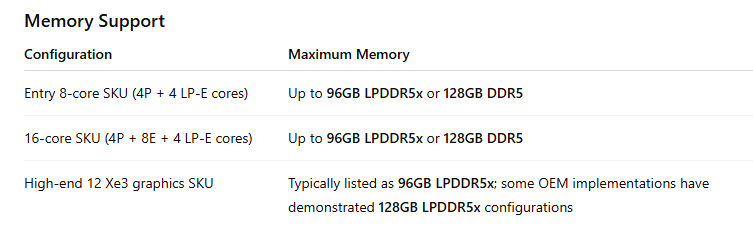
One of the most notable aspects of Panther Lake is the combination of expanded memory support and dedicated AI acceleration. Depending on the processor configuration and laptop design, Panther Lake systems are expected to support up to 96GB of LPDDR5x memory or as much as 128GB of DDR5 memory, providing significantly more flexibility than previous generations that relied on fixed memory configurations.
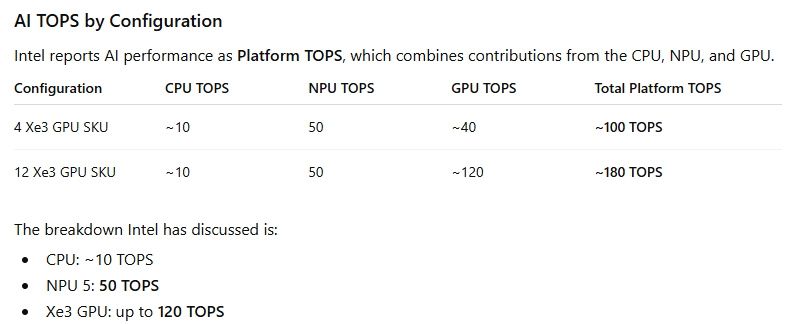
On the AI side, Intel’s highest-end Panther Lake configurations are expected to deliver up to 180 Platform TOPS (Trillions of Operations Per Second) by combining the processing power of the CPU, GPU, and dedicated Neural Processing Unit (NPU). The NPU itself is rated at approximately 50 TOPS, while the integrated Xe3 graphics architecture contributes additional AI acceleration for more demanding workloads.
| Panther Lake Configuration | AI Performance |
|---|---|
| NPU 5 Engine | ~50 TOPS |
| Mid-Range Platform | ~100 TOPS |
| High-End Platform | Up to ~180 TOPS |
For AI workloads such as local assistants, image generation, transcription, and model inference, memory capacity can be just as important as AI compute performance. A system with 96GB to 128GB of memory can accommodate substantially larger datasets, virtual machines, and AI models than previous ultra-portable laptop designs.
The Bigger Picture
Panther Lake reflects a broader shift in the laptop industry. The focus is no longer solely on CPU speed. Modern systems must efficiently coordinate CPUs, GPUs, NPUs, memory, storage, and networking resources to support increasingly AI-driven workflows.
As software vendors continue integrating AI features into everyday applications, platforms that can balance performance, efficiency, memory capacity, and AI acceleration will become increasingly important.
For professionals, developers, creators, and organizations evaluating their next generation of AI-capable laptops, Panther Lake represents Intel’s latest effort to deliver that balance while maintaining the flexibility and openness that have traditionally defined the PC ecosystem.
Final Thoughts
Panther Lake is shaping up to be one of Intel’s most important mobile platforms in recent years. While real-world performance will ultimately depend on final products and independent benchmarks, the architecture introduces several meaningful advancements in AI acceleration, memory flexibility, graphics capabilities, and power efficiency.
For users who want a modern AI-ready laptop without sacrificing platform choice or future configuration flexibility, Panther Lake is a platform worth watching closely as systems begin reaching the market.
References
- Dell Technologies Panther Lake Search
- Intel Core Ultra Series 3 Processors Quick Reference Guide (Intel)
- Intel Newsroom – Panther Lake and AI PC Announcements
- CES 2026: Intel Launches Core Ultra 3 Series Panther Lake Processors (PC Perspective)
- Panther Lake Unveiled: A Deep Dive into Intel’s Next-Gen Laptop CPU (PCWorld)
- What Is Intel Panther Lake? (Windows Central)
- LPCAMM2 Memory Technology Overview (Intel)
- JESD318 LPCAMM2 Memory Standard (JEDEC)
- Apple Silicon Technical Specifications (Apple)
- Apple Developer Documentation – Unified Memory Architecture
- Local AI Community Discussion: Intel Core Ultra 300 Series and AI Performance (Reddit LocalLLaMA)