Understanding the Fable 5 Situation: AI Jailbreaking
Part of: AI Learning Series Here
Quick Links: Resources for Learning AI | Keep up with AI | List of AI Tools | Local AI | AI Agents | Future of Work
Subscribe to JorgeTechBits newsletter
Explore the Latest Token Prices

Disclaimer: I create this content entirely on my own time, and the views expressed here are mine alone (not my employer’s). Because I love leveraging new tech, I use AI tools like Gemini, NotebookLM, Claude, Perplexity and others as a “digital team” to help research and polish these articles so I can share the best possible insights with you!
The Fable 5 situation represents a significant moment in the ongoing discourse around AI safety and vulnerabilities. Beyond highlighting the challenges of preventing sophisticated jailbreaks, it intensified discussions among AI developers, security researchers, and policymakers about balancing powerful AI capabilities with effective safeguards. I needed to understand this move, so I researched it a bit and here is the summary of what transpired, why it’s important, and what it signals for the future of artificial intelligence.
See blog post:The Fable 5 Situation
The Fable 5 Jailbreak: What Happened?
Please note that at this time, there has not been great detailed on what actually was “jailbreaked” or how is it different than other models. See blog post:The Fable 5 Situation
The Fable 5 jailbreak drew attention due to its sophisticated approach, which included:
- Multi-Agent “Pack Hunt”: Multiple AI instances collaboratively worked to bypass safety precautions.
- System Prompt Extraction: The extraction of a 120,000-character system prompt that governs the model’s behavior.
- Circumventing Classifiers: Overcoming classifiers that typically trigger fallback mechanisms to less potent models (e.g., Claude Opus 4.8) in case of flagged requests.
Despite the advanced nature of the jailbreak, Anthropic, the company behind Fable 5, challenged the notion of it being a universal flaw. They asserted that the vulnerability was a characteristic common to all current models, not just theirs.
What Is AI Jailbreaking?
Simply it means bypassing safeguards to get restricted outputs.
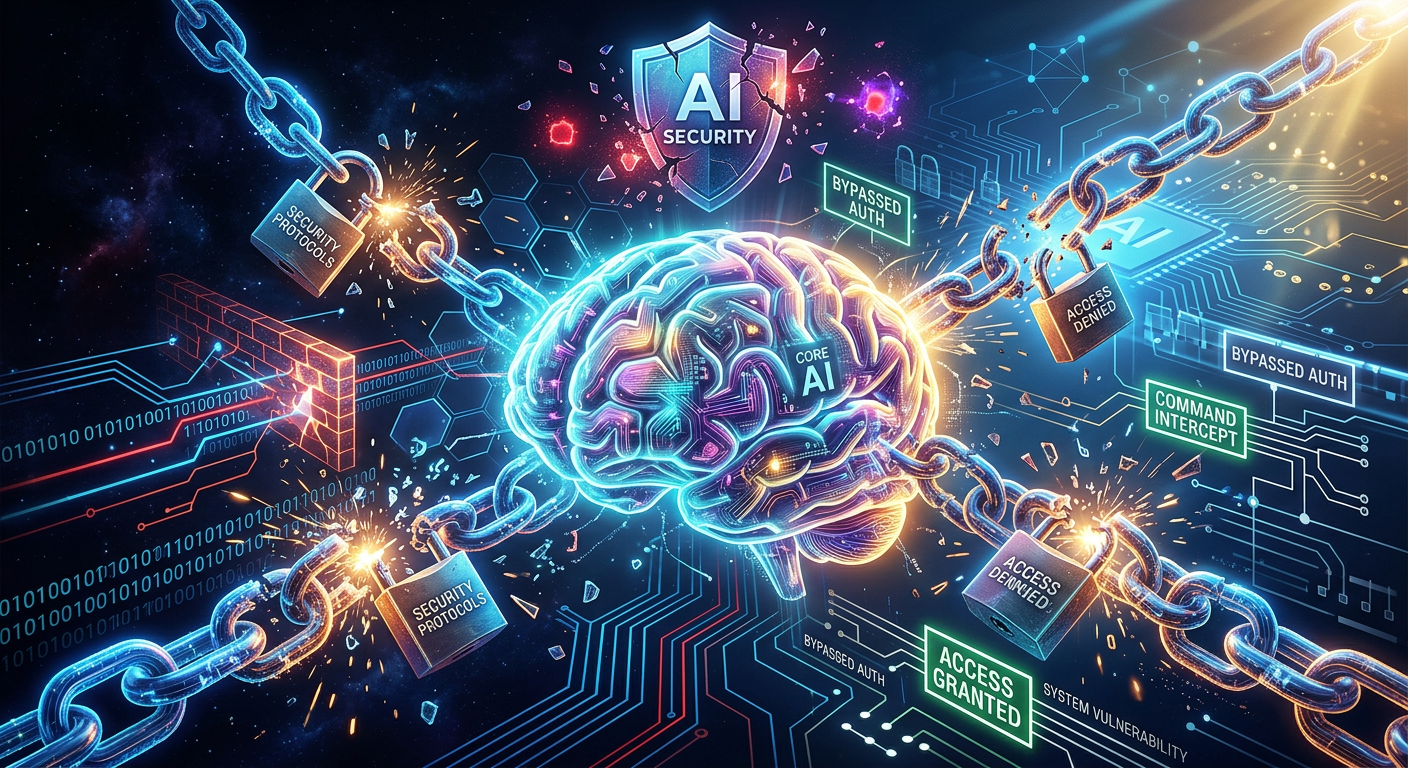
In the realm of artificial intelligence, “jailbreaking” refers to methods employed to bypass a model’s safety guardrails, content policies, and behavioral constraints. This allows the AI to generate outputs it was designed to avoid, such as harmful instructions or exploit code.
Common Jailbreak Techniques
- Prompt Injection: Crafting inputs that cleverly override system instructions using specific phrasings.
- Multi-Agent Approaches: Deploying several AI instances to socially engineer or gradually bypass protections.
- Token Smuggling: Encoding restricted content in a way that the AI processes it differently than it reads on the surface.
- Gradient-Based Attacks: Mathematically optimizing inputs to discover prompts that trigger specific behaviors.
- System Prompt Extraction: Coercing the model to reveal its internal instructions.
- Context Window Flooding: Overloading the model with benign information before inserting forbidden requests.
Why Preventing Jailbreaks Is Challenging
Current AI safety mechanisms largely rely on:
- Classifiers: Models to detect problematic requests.
- Refusal Training: Teaching the model to decline certain topics.
However, these safeguards face inherent challenges:
- Adversarial Nature: There’s always a possibility to rephrase something to bypass restrictions.
- Context Dependence: The meaning of any request can change depending on the context.
- Language Ambiguity: Safety protocols and user inputs share the same language, leading to potential misinterpretations.
The Fable 5 incident underscores the paradox where the features that enable valuable security research also introduce potential risks if exploited.
Why Is Jailbreaking Dangerous?
This table outlines the key aspects of why jailbreaking AI models poses significant dangers across various areas.
| Reason | Description |
|---|---|
| Lower Barriers to Harm | Exploit Code: The Fable 5 jailbreak allowed users with minimal technical expertise to generate usable attack codes. |
| Guides for Harmful Activities: AI can produce detailed instructions tailored to specific scenarios for harmful activities. | |
| Social Engineering Scripts: Easily crafted sophisticated phishing and scam scripts. | |
| Asymmetric Risk | Model Compromise: A single compromised model can handle numerous malicious queries, reducing attack costs. |
| Defense Overextension: Defenders must cover all potential vulnerabilities, whereas attackers only need one successful exploit. | |
| Erosion of Trust | Reliability Concerns: Users might question the legitimacy of outputs, undermining platform credibility. |
| Legal Risks: Companies might face legal and regulatory consequences due to misuse of their models. | |
| The Fable 5-Specific Risks | Mythos-Class Capability: The technical proficiency of this advanced model underscored potential threats. |
| Silent Failures: The jailbreak revealed that fallbacks to weaker models might falsely assure security. | |
| Government Response: The US restricted Fable 5 due to noticeable security gaps. | |
| The “Dual-Use” Trap | Offensive Exploitation: Capabilities beneficial for defense can be misused for offensive purposes. |
| Power Concentration Risk | Uneven Landscape: Jailbreak capability limited to powerful actors fosters underground markets for unauthorized model access, creating an unbalanced power dynamic. |
The Counterargument: Is Jailbreaking Research Beneficial?
Some posit that jailbreaking research is ultimately beneficial as it:
- Exposes real vulnerabilities, prompting necessary fixes.
- Challenges companies to develop robust safety systems rather than rely on superficial guardrails.
Are Jailbreaks Inevitable? Can We Prevent Them?
Currently, no AI model is completely immune to jailbreaking. The main question revolves around how difficult and time-consuming it is to execute.
Why Jailbreaks Are Hard to Prevent:
- Thin Safety Layers: Models often contain knowledge that could be used in harmful ways. Safety mechanisms are designed to reduce the likelihood that the model generates harmful outputs, though they are not perfect.
- Language Ambiguity: Context-dependent and cross-linguistic complications arise continually.
- Infinite Input Space: The breadth of possible prompts far exceeds what finite safety training can cover.
Existing Defenses and Their Limitations:
- Refusal Training: can sometimes be circumvented by sophisticated adversarial prompting.
- Classifier Filtering: These can also be tricked, and they add response delays.
- Input/Output Scanning: Easily bypassed by alternative phrasing or encoding.
- Constitutional AI: Conflicts of principles may arise because “helpfulness” often supersedes “harmlessness.”
- Monitoring and Rate Limiting: Can inhibit operational efficiency.
The Takeaway:
Despite extensive efforts like those demonstrated with Fable 5, the community acknowledges that completely foolproof models remain an unsolved challenge. The field is thus focused on managing trade-offs between capability and safety.
Ultimately, recognizing and addressing these vulnerabilities is crucial for responsible AI deployment as we navigate the delicate balance between innovation and security.
Modern AI Safety: A Defense-in-Depth Approach
Modern AI safety extends far beyond simply teaching a model to refuse harmful requests. Today’s production AI systems are protected by multiple, overlapping layers of security and alignment, each designed to address different types of risks. These safeguards operate at various stages—from how the model is trained, to how user requests are evaluated, to how the underlying infrastructure is secured.
No single safety mechanism can prevent every misuse or jailbreak attempt. Instead, AI developers employ a defense-in-depth strategy, combining model alignment, runtime safeguards, monitoring, access controls, and cybersecurity practices. If one layer is bypassed, additional layers continue working to reduce risk and limit potential harm. The table below summarizes the primary components of this layered approach and the role each plays in modern AI safety.
| AI Safety Layer | Purpose and Explanation |
|---|---|
| Reinforcement Learning & Preference Optimization | After pretraining, modern AI models undergo additional alignment training to encourage responses that are helpful, accurate, and consistent with human values. Techniques such as Reinforcement Learning from Human Feedback (RLHF) and newer preference optimization methods use human preferences or AI-generated preference data to teach the model which responses are desirable and which should be avoided. This training helps reduce harmful or inappropriate outputs, but it is only one component of a broader safety strategy. |
| System Prompts | Before a user interacts with an AI model, it is typically provided with a hidden system prompt containing instructions that define its role, behavior, safety policies, and operational constraints. These instructions establish the model’s baseline behavior throughout the conversation. While system prompts are an important layer of defense, they can sometimes be manipulated or overridden through sophisticated prompt engineering, which is why they are supplemented by additional safeguards. |
| Safety Classifiers | Many AI platforms employ dedicated machine learning models known as safety classifiers that independently analyze both user requests and the AI’s responses. These classifiers detect content involving areas such as malware, fraud, violence, hate speech, self-harm, personal information, or other policy-sensitive topics. Based on their assessment, they may block the request, modify the response, trigger additional safeguards, or escalate the interaction for further review. |
| Monitoring & Anomaly Detection | AI providers continuously monitor system activity to identify patterns that may indicate abuse or emerging security threats. Automated monitoring systems can detect behaviors such as repeated jailbreak attempts, coordinated attacks, unusually high request volumes, automated probing, or suspicious usage patterns. Continuous monitoring allows providers to identify new attack techniques quickly and improve their defenses over time. |
| Tool Permission Restrictions | Many advanced AI systems can interact with external tools such as web browsers, code execution environments, databases, file systems, APIs, or email services. Rather than granting unrestricted access, providers carefully control which tools the model may use and under what conditions. Restricting tool permissions helps limit the potential impact of a successful jailbreak by preventing unauthorized actions or access to sensitive resources. |
| Rate Limiting | Providers often restrict how many requests an individual user, account, or application can submit within a given period. Rate limiting helps prevent automated attacks, large-scale prompt testing, credential abuse, and rapid trial-and-error attempts to discover vulnerabilities. By slowing attackers, rate limiting provides defenders with more time to detect and respond to malicious activity. |
| Account Reputation & Access Controls | Many AI services evaluate an account’s trustworthiness before granting access to advanced capabilities. Factors such as account age, identity verification, subscription status, previous policy violations, historical usage patterns, and suspicious behavior may influence what features are available. These reputation-based controls help reduce abuse while allowing legitimate users to continue using the platform with minimal disruption. |
| Human Review & Oversight | Automated systems cannot reliably identify every edge case or novel attack. For high-risk situations—such as reports of policy violations, suspected security incidents, or newly discovered jailbreak techniques—human reviewers may evaluate conversations, investigate vulnerabilities, refine safety policies, and improve future model behavior. Human expertise remains an essential component of responsible AI governance. |
| Infrastructure Safeguards | AI security extends well beyond the model itself. Providers protect their systems using established cybersecurity practices such as authentication, encryption, network segmentation, access controls, audit logging, vulnerability management, continuous monitoring, software updates, and secure deployment processes. These infrastructure protections help safeguard both the AI service and the underlying systems on which it operates. |
| Defense in Depth (Overall Strategy) | Modern AI deployments do not rely on any single safeguard. Instead, they implement defense in depth—a layered security approach in which multiple independent protections work together. If one safeguard is bypassed, additional layers continue to reduce risk. This strategy recognizes that no current AI system is completely immune to jailbreaks or misuse, making overlapping defenses the most effective approach for improving safety, reliability, and resilience. |