Microsoft 365 Copilot : Pay-Per-Click – Variable Costs
Part of: AI Learning Series Here
Quick Links: Resources for Learning AI | Keep up with AI | List of AI Tools | Local AI | AI Agents | Future of Work
Subscribe to JorgeTechBits newsletter
Explore the Latest Token Prices
Disclaimer: I create this content entirely on my own time, and the views expressed here are mine alone (not my employer’s). Because I love leveraging new tech, I use AI tools like Gemini, ChatGPT, Claude, Perplexity and others as a “digital team” to help research and polish these articles so I can share the best possible insights with you!
The enterprise AI boom has hit a bit of a financial wall. What began as an exciting race to adopt generative AI tools across organizations has rapidly morphed into a budgeting headache. As companies expand from basic chat interfaces to autonomous agents and automated workflows, the underlying compute costs are proving unsustainable.
Here is a look at why enterprise AI costs are spiraling out of control, how Microsoft is fundamentally restructuring its AI infrastructure to fix it, and what it means for the future of IT spending.
1. The Core Challenge: The Economics of Enterprise AI
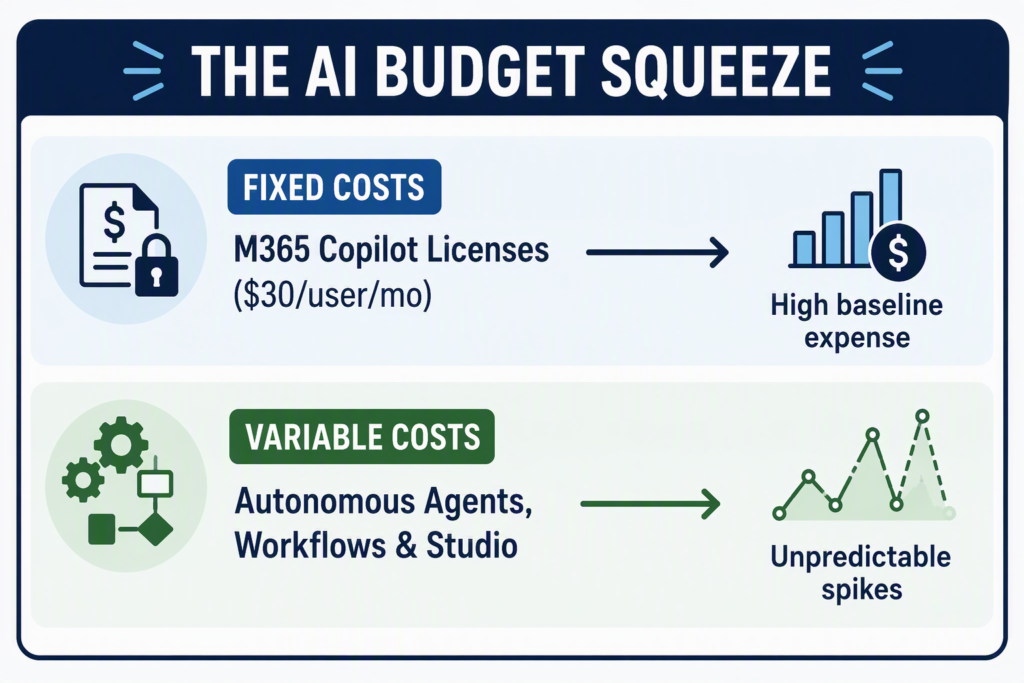
Organizations adopting enterprise AI tools—like Microsoft 365 Copilot—face two primary cost drivers: fixed seat licenses and variable consumption fees. While fixed per-user licenses are predictable, the shift toward autonomous, agentic AI has exposed deep economic flaws in how businesses consume compute.
The “Paper Cut” Dilemma
The main driver of ballooning AI bills isn’t necessarily heavy tasks; it’s over-provisioned compute for basic queries.
When employees ask an AI tool to locate a document, summarize a three-sentence email, or rephrase a paragraph, systems historically routed those requests to massive, state-of-the-art “frontier” models (such as top-tier models from OpenAI or Anthropic).
Running high-volume, low-effort tasks through multi-billion-parameter reasoning models is the equivalent of hiring a board-certified brain surgeon to put a band-aid on a minor scrape. The model completes the task effortlessly, but the organization pays a massive premium in compute power and token credits.
2. Microsoft’s Strategy: In-House MAI & Multi-Model Orchestration
To keep enterprise AI viable at scale, Microsoft is shifting away from heavy reliance on third-party frontier models for everyday tasks. They are deploying a proprietary, specialized family of models called MAI (Microsoft AI) alongside an intelligent system architecture known as Multi-Model Orchestration.
How Model Routing Works
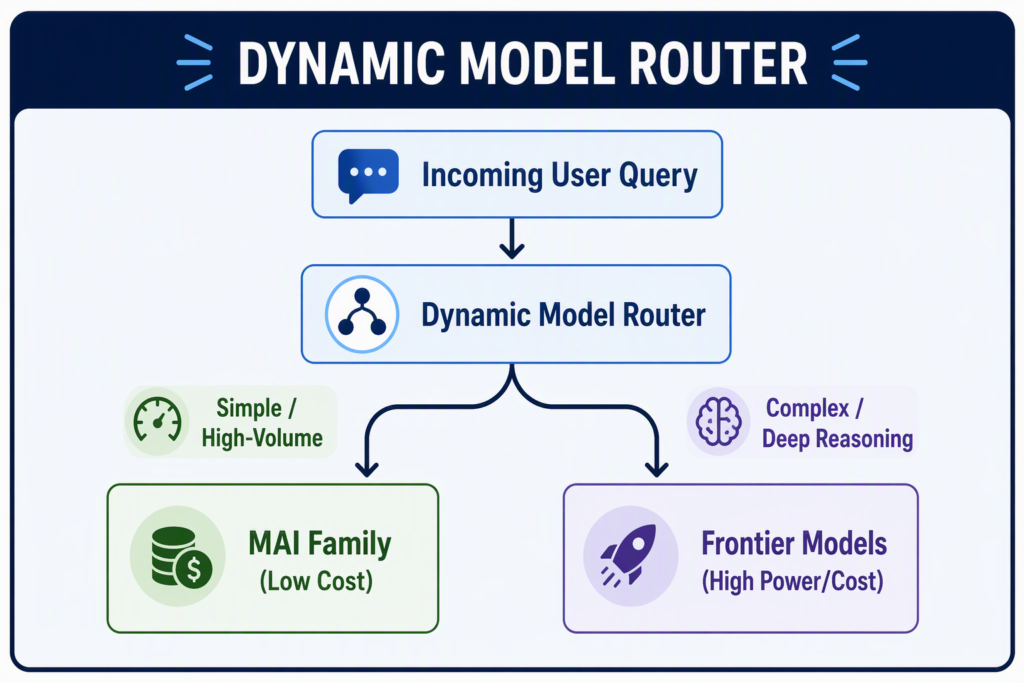
Instead of sending every request to the largest available model, an automated routing layer evaluates the complexity of the incoming prompt:
- Low-Effort & Routine Tasks: Automatically directed to lightweight, specialized MAI models optimized for specific domains (coding, voice, text generation).
- Complex, Multi-Step Tasks: Directed to heavy-duty reasoning models only when advanced logic or deep contextual understanding is explicitly required.
3. The MAI Suite Breakdown
Microsoft’s in-house suite is purpose-built to cover the most common enterprise workloads without the massive compute overhead:
| Model | Domain Focus | Targeted Enterprise Workloads |
| MAI Thinking 1 | Deep Reasoning & Logic | Multi-step planning, mathematical analysis, and long-document breakdown. |
| MAI Code 1 Flash | Software Engineering | High-speed code generation, refactoring, and automated GitHub workflows. |
| MAI Image 2.5 | Computer Vision & Design | Dynamic image generation and editing within M365 apps. |
| MAI Voice 2 | Text-to-Speech | Real-time speech synthesis and multilingual translation (e.g., Teams Premium). |
| MAI Transcribe 1.5 | Speech-to-Text | Low-latency meeting transcription and audio-to-text conversion. |
4. Financial Impact on Enterprise IT
While this architectural change happens mostly behind the scenes, it delivers three direct financial benefits to enterprise budgets:
- Shielding Base License Prices: Lowering internal infrastructure costs allows Microsoft to absorb growing usage demands without pushing up the baseline $30/user monthly Copilot seat fee.
- Extending Token & Credit Value: Because pay-as-you-go consumption and Copilot credits are tied to model strain, routing basic tasks to efficient MAI models reduces token drain per action.
- Granular Developer Control: IT departments and developers building custom agents in tools like Copilot Studio can design multi-tiered workflows—using cheap MAI models for preliminary data gathering and saving expensive frontier models for final synthesis.
5. Local AI and Hybrid AI: The Next Step Toward Sustainable Enterprise Intelligence
While smarter model routing significantly reduces cloud AI costs, Microsoft is also investing heavily in another long-term solution: Local AI and Hybrid AI architectures.
The reality is that not every AI task needs to be processed in a hyperscale datacenter. Many enterprise workloads involve routine summarization, document analysis, search, classification, and productivity scenarios that can increasingly run on modern AI-capable devices equipped with NPUs (Neural Processing Units) and dedicated AI accelerators.
This is where Microsoft’s emerging Foundry Local strategy becomes particularly important. Foundry Local enables organizations to deploy and run optimized AI models directly on endpoints, edge systems, and local infrastructure while maintaining seamless integration with cloud-based AI services when additional scale or reasoning power is required.
The result is a hybrid execution model:
- Simple, high-frequency tasks can run locally on the device, eliminating cloud inference costs and reducing latency.
- Business-sensitive workloads can remain on-premises or at the edge for improved data governance and compliance.
- Complex reasoning tasks can still be escalated to cloud-hosted MAI or frontier models when deeper analysis is required.
- Organizations gain greater control over AI spending by balancing local compute resources with cloud-based AI consumption.
In many ways, this mirrors the evolution of traditional computing. Not every workload belongs in the cloud, and not every workload belongs on the endpoint. The future will likely be a dynamic blend of both. Microsoft’s investments in MAI models, intelligent model routing, and Foundry Local suggest a vision where AI workloads are automatically executed in the most cost-effective location, whether that’s on the device, at the edge, or in the cloud.
The Future of Sustainable AI
The future of enterprise AI isn’t just about making models bigger; it’s about making execution smarter, more efficient, and more cost effective. Microsoft’s approach combines three complementary strategies: specialized MAI models, intelligent multi-model orchestration, and an emerging Local/Hybrid AI ecosystem powered by technologies such as Foundry Local.
Together, these innovations aim to reduce infrastructure costs, preserve AI performance, and create a more financially sustainable path toward large-scale AI adoption. By dynamically routing workloads to the right model and, increasingly, the right execution location, Microsoft can optimize both performance and cost across the enterprise.
For IT leaders, the future of AI may not be cloud-first or device-first, but rather choosing the right model, in the right location, for the right task, at the right cost. As Local AI capabilities continue to mature and Foundry Local evolves, organizations will gain even greater flexibility to balance cloud scale, endpoint intelligence, security, and economics.
Resources:
- For my previous Copilot related blog posts here